


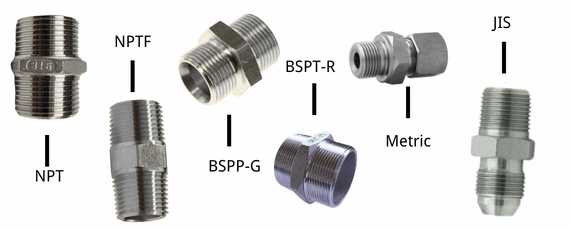
Pipe thread types include NPT, NPTF, BSPP, BSPT, metric, SAE and JIS connections. They differ in thread angle, taper, pitch, size designation and sealing method. Before selecting a fitting, you should identify all these features, not just the measured thread diameter. Different threads can sometimes engage for a few turns without forming a correct or pressure-tight connection.
What Is a Pipe Thread?
A pipe thread connects a pipe, valve, fitting, manifold or instrument port. Some pipe threads both connect and seal the joint. Others only hold the parts together while an O-ring, gasket or metal seat creates the pressure seal.
Tapered Pipe Threads
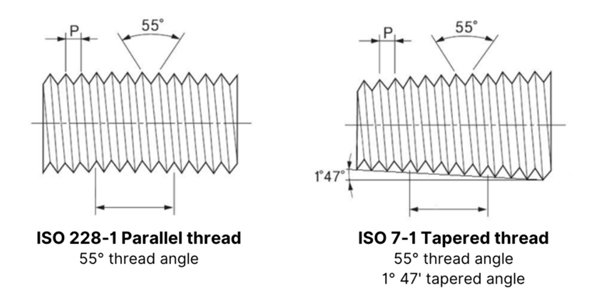
Tapered threads increase in diameter along their length. NPT and BSPT are common examples. Tightening produces interference between the male and female threads, normally with a suitable thread sealant.
Parallel or Straight Threads
Parallel threads maintain a constant diameter. BSPP, SAE O-ring boss and many metric connections use parallel threads. These connections generally seal with an O-ring, washer, gasket or shaped sealing surface.
One important exception is the ISO 7-1 Rp parallel female thread, which is intended to mate with an R tapered male thread in a connection that seals at the threads.
Thread tape cannot replace a missing or damaged O-ring or gasket.
Common Types of Pipe Threads
Types of pipe threads fall into five major families. Each family has its own standard, thread angle, and sealing method.
NPT and NPTF Threads
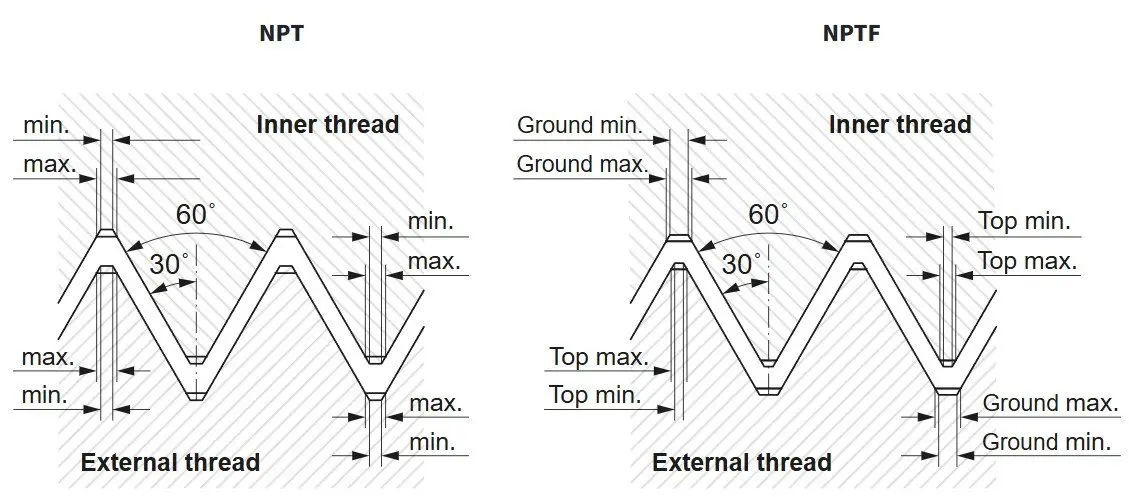
NPT stands for National Pipe Taper. It is a 60° tapered thread defined by ASME B1.20.1 and widely used in North American instrumentation, process piping and general industrial equipment.
An NPT joint normally requires an approved paste or tape sealant to fill the spiral leak path and reduce galling during assembly.
NPTF is a dryseal thread covered by ASME B1.20.3. It uses controlled crest and root interference to reduce leakage. Do not assume that every NPTF application must be assembled without sealant; follow the equipment manufacturer’s instructions.
British Pipe Threads
British pipe threads are Whitworth threads with a 55° thread angle. They are divided into two main groups.
BSPP, commonly marked G, is parallel. The thread holds the components together, while a gasket, bonded washer or O-ring provides the seal.
BSPT is tapered. Under ISO 7-1, R identifies a tapered male thread, Rp a parallel female thread and Rc a tapered female thread. R male threads are intended to mate with correctly specified Rp or Rc female threads.
NPT and BSPT may engage for a few turns, but they are not interchangeable. NPT has a 60° thread form, while BSP uses 55°. Pitch and profile can also differ. See our guide to NPT vs BSP threads for a detailed comparison.
.png)
Metric Threads
A metric thread designation states the nominal major diameter and pitch in millimeters. For example, M14 × 1.5 indicates a nominal major diameter of 14 mm and a pitch of 1.5 mm.
ISO metric threads have a 60° thread angle. However, the metric thread designation alone does not identify the sealing method. Depending on the connection design, sealing may use an O-ring, washer or cone seat.
Two fittings with the same metric thread size may still have incompatible sealing surfaces. Confirm both the thread and the complete connection geometry.
SAE Threads and Hydraulic Connections
SAE connections often use parallel UN or UNF threads. SAE O-ring boss connections seal with an O-ring; JIC and SAE flare fittings seal at a metal seat. The 37° or 45° value describes the flare seat, not the thread angle.
JIS Pipe Threads
JIS pipe threads are commonly encountered on Japanese equipment. JIS B 0202 covers parallel pipe threads, while JIS B 0203 covers taper pipe threads.
Older drawings may use PT or PF markings, while other drawings may show G, R, Rp or Rc. Check the referenced standard and drawing edition before selecting a mating fitting.
Pipe Thread Types Comparison Chart
To compare different types of pipe threads, use the table below. It covers the most common standards in instrumentation, small-bore process, hydraulic, and general piping.
| Thread Type | Standard | Angle | Taper / Parallel | Sealing Method | Common Applications |
| NPT | ASME B1.20.1 | 60° | Tapered | Sealant | US/Canada gas, water, oil |
| NPTF | ASME B1.20.3 | 60° | Tapered | Dry seal (metal-to-metal) | Fuel, hydraulic, no sealant |
| BSPP / G | ISO 228-1 | 55° | Parallel | O-ring / gasket | Europe, Asia, pneumatic |
| BSPT / R | ISO 7-1 | 55° | Tapered | Sealant | Europe, Asia, general piping |
| Rp | ISO 7-1 | 55° | Parallel female | Sealant with R male | Mates with BSPT male |
| Rc | ISO 7-1 | 55° | Tapered female | Sealant with R male | Mates with BSPT male |
| Metric | ISO 68-1 | 60° | Parallel | Washer / O-ring | Global machinery, automotive |
| SAE J512 | SAE J512 | 45° | Tapered flare | Flare seat | Automotive, low pressure |
| SAE J514 | SAE J514 | 37° | Flare | Flare seat | Hydraulic |
| SAE J1926 | ISO 11926 | — | Straight | O-ring boss | Hydraulic ports |
| JIS B0203 | JIS B0203 | 55° | Tapered | Sealant | Japan, similar to BSPT |
| JIS B0202 | JIS B0202 | 55° | Parallel | O-ring / gasket | Japan, similar to BSPP |
How to Read Pipe Thread Sizes
Nominal Size Is Not the Measured Diameter
Inch pipe thread sizes, such as 1/4 NPT and G 1/2, are nominal designations. They do not mean that the external thread diameter measures exactly 1/4 inch or 1/2 inch.
For tapered threads, the measured diameter also changes with the measurement position. Compare the measurement with the correct thread standard rather than converting the nominal size directly into millimeters.
Pitch and Threads per Inch
Inch threads commonly express pitch as threads per inch (TPI). Metric threads normally express pitch as the distance between adjacent thread crests in millimeters.
For an inch thread, pitch in millimeters can be calculated as:
Pitch (mm) = 25.4 ÷ TPI
This conversion describes spacing only. Equal or similar pitch does not establish compatibility between different thread standards.
Common Thread Marking Examples
| Marking | Meaning |
| 1/4-18 NPT | Nominal 1/4-inch NPT thread, 18 TPI |
| G 1/4 | Nominal 1/4-inch parallel pipe thread under ISO 228-1 / ISO 228-1 |
| R 1/4 | Nominal 1/4-inch tapered male pipe thread under ISO 7-1 / ISO 7-1 |
| M14 × 1.5 | 14 mm nominal major diameter, 1.5 mm pitch |
| 7/16-20 | 7/16-inch nominal major diameter, 20 TPI; additional connection details are required |
A complete order should specify more than a size. Include the thread standard, male or female form and sealing arrangement.
How to Identify Pipe Threads
Check markings and documentation. Look for a thread designation, drawing or equipment specification.
Determine whether it is tapered or parallel. Compare diameters at different positions along the thread.
Measure the diameter. Measure the male thread’s outside diameter or the female thread’s inside diameter as required by the identification guide.
Measure the pitch. Use a thread pitch gauge to determine TPI or metric pitch.
Check the thread profile. Confirm the specified angle and form.
Inspect the sealing features. Look for an O-ring groove, gasket face, cone or flare seat.
Confirm against the correct standard. Check dimensions, tolerances and the complete mating connection.
Do not use a trial fit as proof of compatibility. Different threads can sometimes engage for a few turns without forming a correct or pressure-tight connection.
What to Check Before Selecting a Fitting
Thread compatibility is only one part of fitting selection. Also confirm:
- The connection specification and size at each end.
- Male or female configuration.
- The required fitting shape, such as a nipple, adapter, elbow or tee.
- Material compatibility with the process fluid.
- Working pressure and operating temperature.
- Seal material and assembly requirements.
Size availability and pressure ratings vary by fitting series, material and configuration. Do not apply one product’s maximum size or pressure rating to every fitting with the same thread type.
Where an O-ring or gasket is used, its temperature and fluid compatibility may limit the complete connection.
FAQ
Q1. What are the main types of pipe threads?
The main types of pipe threads are NPT, NPTF, BSPP (G), BSPT (R), Metric, SAE, and JIS.
Q2. Are British pipe threads compatible with NPT?
No. NPT has a 60° angle; British pipe threads have a 55° angle. They are not interchangeable.
Q3. Is a 1/2-inch pipe thread 12.7 mm in outside diameter?
No. The 1/2-inch designation is a nominal pipe size. The actual external thread diameter is larger than 12.7 mm and depends on the standard and, for tapered threads, the measurement position.
Q4. What are the different types of pipe threads for hydraulic fittings?
Common hydraulic threads include NPT, NPTF, SAE J514 (37° flare), SAE J1926 (O-ring boss), and BSPP (G).
Q5. Do all threaded connections require thread tape?
No. NPT and BSPT connections normally use suitable thread sealant, which may be tape or paste depending on the application. Connections designed to seal with an O-ring, gasket or flare seat rely on those features instead. Follow the manufacturer’s assembly instructions.
Contact Us
NPTLOK offers high-quality NPT and BSPP thread fittings to help you build more reliable, longer-lasting connections. If you require other thread types, we can also provide them. NPTLOK manufactures instrumentation tube fittings and valves for more than 20 years with an ISO certificate.
We offer a full range of NPT and BSPP thread fittings up to 2″. For any inquiries or to download our product catalog, please feel free to contact us.


