


What is a nipple in piping? A حلمة أنبوب is basically a short hollow fitting, normally male-threaded at both ends. In instrument setups, it connects the female-threaded ports on valves, manifolds, instruments, and other fittings.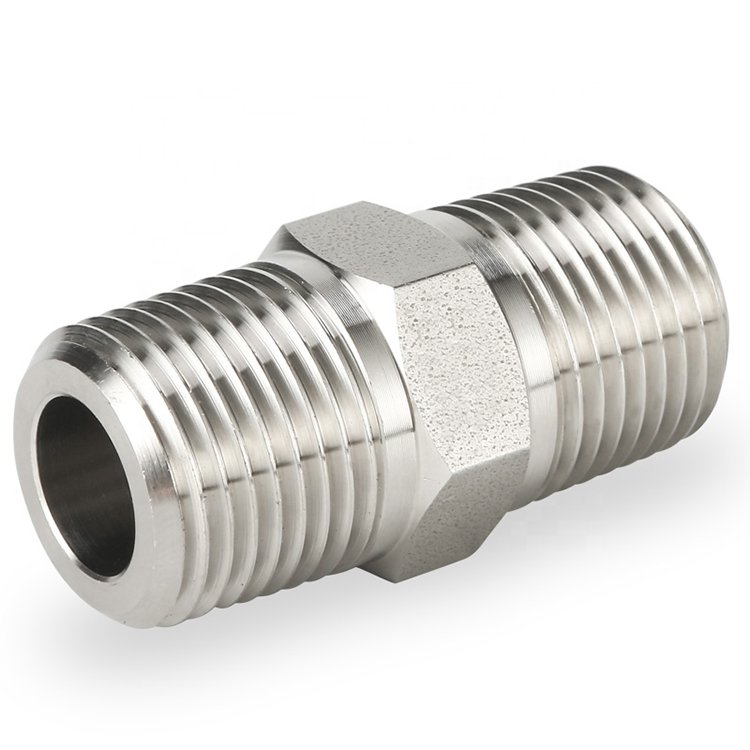
What Is a Pipe Nipple Used For?
A valve with a female threaded port and an elbow with another female threaded port cannot screw directly into each other. A nipple provides the male connection at each end and a passage for the fluid between them.
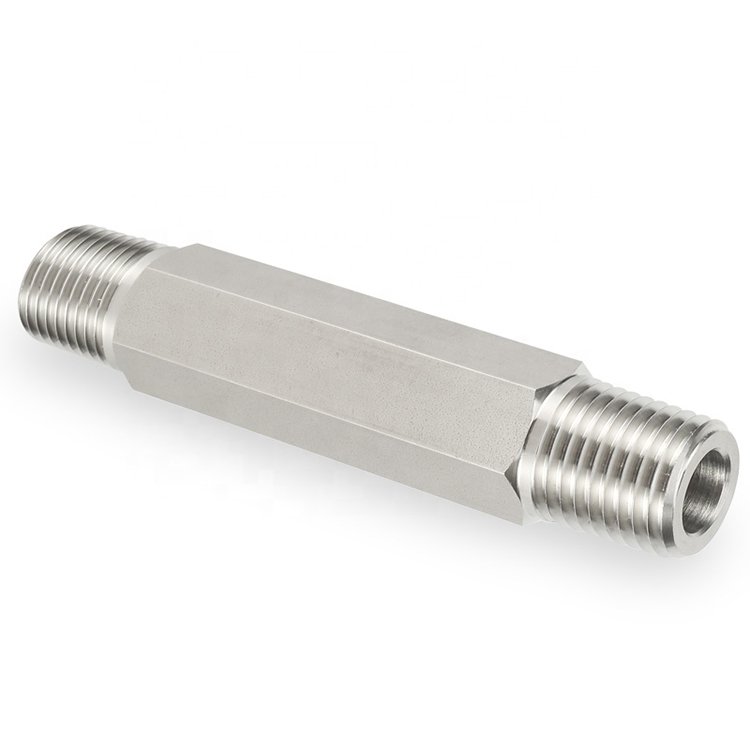
It can also provide clearance between components. A longer nipple may make room for a valve handle, insulation or a wrench. A close nipple brings the components nearer together when space is limited.
In instrumentation assemblies, choosing the right length is therefore part of planning access for installation and maintenance, as well as making the connection.
Common Types of Pipe Nipples
The names below describe different features. For example, a nipple can be both stainless steel and hexagonal, those are not competing classifications.
| يكتب | Identifying feature | Main purpose |
| Barrel nipple | Cylindrical body with threads at both ends | Connects components with a specified separation |
| Close nipple | Little or no unthreaded space between the end threads | Makes a compact connection |
| Shoulder nipple | A short unthreaded section | Provides slightly more separation than a close nipple |
| Hex nipple | Hexagonal wrench flats between the ends | Provides a defined gripping surface |
| Long hex nipple | Extended body with wrench flats | Adds clearance while retaining wrench access |
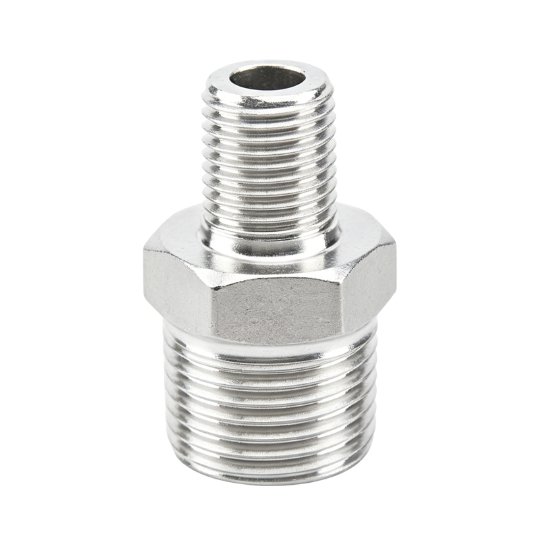
| تصغير الحلمة | Different connection sizes at the ends | Joins unequal female port sizes |
What Is an NPT Nipple?
An NPT nipple has National Pipe Taper threads on its threaded ends. A male NPT-to-male NPT nipple connects two matching female NPT ports.
NPT refers to the thread system. A hex nipple and a barrel nipple can both have NPT threads.
Don’t assume two fittings will work together just because their nominal sizes match. NPT and BSP threads have different profiles, and a connection that starts to screw together isn’t proof that it’s compatible. If you need to transition between thread types, use a fitting with the correct connection at each end.
Pipe Nipple Materials

Black steel / black pipe nipple
Black pipe nipples are generally carbon steel nipples supplied without a zinc coating. They are used in piping systems that specify carbon steel, including suitable fuel-gas and industrial services.
Generally speaking, it is best to galvanize the surface of a carbon steel pipe nipple, as this provides greater corrosion resistance and higher hardness. These are also called galvanized pipe nipples.
Stainless steel nipple
Common stainless steel grades include 304, 316, and 316L. Compared with 304, the molybdenum in 316 and 316L generally improves resistance to chloride-related pitting and crevice corrosion.
Brass nipple
Brass pipe nipples should preferably have a chrome-plated surface to protect the brass from oxidation and corrosion.
Regarding pipe fitting materials, brass costs less than carbon steel, and carbon steel costs less than stainless steel. Please choose according to your different requirements for corrosion resistance, strength, and price. Generally speaking, for corrosive media or high pressure, choose 316 stainless steel. For clean water, air, or low pressure, choose brass. For oil, gas, or dry service, choose carbon steel.
How to Read Pipe Nipple Sizes
Connection Size
The connection has to match the threaded port it screws into—whether that’s on a valve, manifold, or instrument. When you see 1/4-inch NPT, that’s the nominal thread size. It doesn’t tell you the bore is 1/4 inch, and it doesn’t mean the nipple takes 1/4-inch tubing. If the two ends are different, write both out. For example: 1/2-inch male NPT × 1/4-inch male NPT.
Overall Length
Overall length is measured across both threaded ends. Remember that some of that length goes inside the mating ports once assembled. If you’re putting a gauge on an isolation valve, leave enough room for the gauge body—and enough room to actually get a wrench in there.
Bore
Bore is the inside passage for flow. You’ll find it on the fitting drawing. Two nipples can share the same thread size but have different bores, especially when one is a standard design and the other is high-pressure. Read the bore from the catalog. Don’t calculate it from the nominal connection size.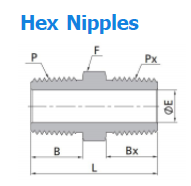
Pipe Nipple Installation Notes
With NPT nipples, look at the port threads first and figure out where the instrument needs to end up before you start assembling.
Clean Threads
Check the nipple and the mating port for burrs, damaged threads, and old sealant. Don’t let debris get into the instrument connection. Start threading by hand. If it binds on the first turn, something’s off—misalignment or mismatched threads.
Thread Seal Tape
Put a sealant on the male threads that’s approved for the process fluid and temperature. Keep the first few threads clear. Loose tape or too much compound can find its way into small instrument passages. Follow the sealant maker’s instructions for application and curing.
Tightening Torque
Use the tightening procedure specified for the fitting and the equipment it’s mating with. NPT torque changes with size, material, and sealant. Put the wrench on the designated flats, and hold the mating connection with a second wrench. Never use the gauge or transmitter housing as a lever.
Avoid Overtightening
Don’t force an extra turn just to get a gauge face pointing the right way. Over-tightening can damage the instrument port, and backing off can disturb the seal. If the orientation is wrong, remake the connection or use one designed for adjustment. Only make adjustments after isolation and depressurization—then leak-test before putting it into service.
التعليمات
Q1. What is the difference between a pipe nipple and a coupling?
A typical threaded nipple has male threads on both outside ends. A typical threaded coupling has female threads inside. They connect different combinations of mating parts.
Q2. Does every pipe nipple have threads at both ends?
No. Threaded both ends, or TBE, is common. Threaded one end, or TOE, also exists, along with weld-end and other styles. Check the drawing for the actual end prep. TOE alone doesn’t tell you what the other end looks like.
Q3. What Does “2 Inch Black Pipe Nipple” Mean?
It usually means a black carbon steel nipple with 2-inch nominal pipe size.
Q4. Is a 2-inch pipe nipple always 2 inches long?
No. “2 inch” often means nominal connection size, not actual length. Overall length is a separate spec and must be listed. If only one dimension appears, ask which measurement it is.
Q5. Are black pipe nipples and galvanized nipples the same?
No. Both can be carbon steel, but galvanized nipples have a zinc coating and black nipples don’t. Coating compatibility and corrosion behavior differ. Same thread size doesn’t mean they can be swapped in every service.
اتصل بنا
نبتلوك’s pipe nipple includes hex nipples, long hex nipples, close nipples and special pipe nipples, with dimensions and material-dependent ratings for the listed configurations.
Materials we commonly use include stainless steel, carbon steel, brass, and other special materials including مونيل, Alloy, Super Duplex, and so on.
If you require carbon steel material, we will do galvanizing on the surface of pipe nipples. If you require brass pipe nipple, we will make the chrome-plated treatment on the surface of brass pipe nipples.
يتعلم أكثر معلومات عنا or download our كتالوج.
Send us your connection sizes, thread standards, required length and operating conditions. We can help identify a suitable catalog configuration for your assembly.


