


The short answer is NO – NPT and BSP threads are not interchangeable. NPT has a 60° thread angle, while BSP has a 55° angle. Threaded fittings are essential. Here is exactly why, and how to tell them apart in 3 simple steps.
What Is an NPT Thread
معاهدة حظر الانتشار النووي (National Pipe Tapered) follows ASME B1.20.1, which is the default standard across North American pipe systems.
Key Features
Tapered Design
All NPT threads feature a tapered profile. The taper rate is 1 inch in 16 inches (3/4 inch per foot), measured on the diameter. The angle between the taper and the center axis of the pipe is 1°47‘24’‘ (1.7899°). This taper creates a wedging effect when the male and female threads are tightened together, producing a mechanical seal through metal-to-metal interference.
60° Thread Angle
NPT threads have a 60° thread angle, measured between the sides of the thread.
Flat Peaks and Valleys
NPT threads feature flat peaks and valleys, known as the Sellers thread form as well. Because of the slight clearance between the roots and crests, a spiral leak path exists along the thread. This is why thread sealant or PTFE tape is required to achieve a leak-free seal.
Common Applications
- Water supply systems
- Natural gas pipelines
- الأنظمة الهيدروليكية
- Pneumatic systems
What Is a BSP Thread?
BSP(British Standard Pipe) threads are widely used in Europe, Asia, Australia, and many other regions outside North America. BSP is governed by ISO 7-1 and ISO 228-1, and is divided into two distinct sub-types: BSPT and BSPP.
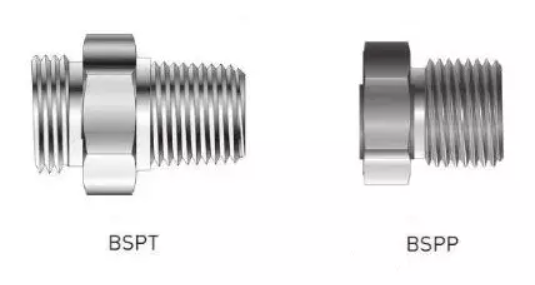
BSP is the area where we encounter the most confusion. We’ve had instances where a customer placed an order for “BSPP threads,” but the factory mistakenly interpreted this as the Chinese ZG thread (where ZG refers to BSPT/R, a tapered thread), while the customer actually needed G (parallel) threads—that is, the ISO 228 standard. Besides, some customers believe that BSPP corresponds to ISO parallel threads (RS) and BSPT corresponds to ISO tapered pipe threads (RT). Interpretations vary among different customers and manufacturers.
Therefore, when you purchase BSP threads, be sure to confirm whether you need tapered threads (R / Rc / Rp) or parallel threads (G). This simple confirmation can save you weeks of rework.
BSPT (British Standard Pipe Tapered)
Design
BSPT threads are tapered at the same 1:16 ratio as NPT threads (1°47‘), but they follow the Whitworth thread form. BSPT is governed by ISO 7-1 (formerly BS 21) and is designed for pressure-tight joints made on the threads themselves.
طريقة الختم
BSPT threads seal through the wedging action of the tapered threads, with contact made on the flanks. Thread sealant or PTFE tape is recommended to ensure a pressure-tight seal by filling the voids between threads.
Identification
External tapered threads are designated by the letter R, while internal parallel or tapered threads are designated by Rp أو Rc.
Supplementary Explanation:
R = male BSPT
Rc = female BSPT
Rp = female BSP parallel-compatible thread
BSPP (British Standard Pipe Parallel)
Design
BSPP threads are parallel (straight)—the diameter remains constant from end to end. BSPP is governed by ISO 228-1 (formerly BS 2779) and is designed for joints where pressure-tight seals are not made on the threads themselves.
طريقة الختم
Because BSPP threads are parallel and do not create a wedging seal, they require an additional sealing element. Common sealing methods include:
Bonded washers (Dowty seals)
O-rings
Copper crush washers
The seal is typically made at the face of the fitting rather than through the threads. This makes BSPP connections easier to reuse than tapered thread connections.
Identification:
BSPP threads are often designated with the letter G (e.g., G 1/4, G 1/2).
Detailed Comparison: NPT vs. BSP
| ميزة | معاهدة حظر الانتشار النووي | BSPT | BSPP |
| Standed | ASME B1.20.1 | ISO 7-1 (BS 21) | ISO 228-1 (BS 2779) |
| Thread Form | Sellers | Whitworth | Whitworth |
| Thread Angle | 60° | 55° | 55° |
| Profile | Tapered (1:16) | Tapered (1:16) | Parallel (straight) |
| Peaks & Valleys | Flat | Rounded | Rounded |
| طريقة الختم | Thread wedging + sealant | Thread wedging + sealant | O-ring, bonded washer, or crush washer |
| Primary Region | North American | UK, Europe, Asia, Australia, Africa | UK, Europe, Asia, Australia, Africa |
| Designation | معاهدة حظر الانتشار النووي | R / Rp / Rc | G |
NPT and BSP are different pipe thread standards.
The main differences are:
NPT: 60° thread angle, flat crest/root, mainly North America
BSP: 55° thread angle, rounded crest/root, widely used internationally
NPT and BSP cannot be directly connected without an adapter
How to Identify and Distinguish NPT and BSP Threads
Step 1: Check for Thread Tapered or Parallel
Tapered threads indicate either NPT (60°) or BSPT (55°).
Parallel threads indicate BSPP (55°).
.png)
Step 2: Measure the Threads Per Inch
Use a thread pitch gauge to measure the number of threads per inch. Compare your measurement against standard values:
| Pipe Size | NPT (TPI) | BSP (TPI) |
| 1/8” | 27 | 28 |
| 1/4” | 18 | 19 |
| 3/8” | 18 | 19 |
| 1/2” | 14 | 14 |
| 3/4” | 14 | 14 |
| 1” | 11.5 | 11 |
Step 3: Inspect the Thread Angle and Profile Shape
Examine the shape of the thread peaks and valleys:
- NPT threads have a 60° angle with flat peaks and valleys (Sellers thread form)
- BSP threads have a 55° angle with rounded peaks and valleys (Whitworth thread form)
This difference can often be observed with a magnifying glass or by using a thread profile gauge. The 5-degree difference in angle and the rounded vs. flat profile are definitive identifiers.
FAQs
Q1. Can I connect an NPT male fitting to a BSPT female port?
No. NPT uses a 60° thread angle, while BSP uses 55°. They may start to thread together, but they will not seal. Use a proper adapter.
Q2. When should I choose NPT over BSP?
You could determine it depends on two factors. One is the region, and the other is the maintenance frequency. North America uses NPT, while most other regions use BSP.For frequent disassembly, choose BSPP (O‑ring face seal). For permanent or infrequent joints, NPT or BSPT works fine. Always match your existing system.
Q3. Does BSPP thread need Teflon tape or sealant?
No. BSPP seals via an O‑ring or washer at the face – not through the threads. Applying tape increases friction, prevents the O‑ring from seating properly, and may introduce debris into the line. Only tapered threads (NPT/BSPT) require thread sealant.
NPT and BSP Thread Solutions from NPTLOK
NPTLOK manufactures precision tube fittings and valves with NPT, BSPT, and BSPP thread options to meet different international installation requirements.
Our products are available in stainless steel 316/304, carbon steel, brass, and aluminum.
Thread types available:
NPT (ASME B1.20.1)
BSPT (ISO 7-1, RT) — tapered
BSPP (ISO 228, RS/RP) — parallel
Whether you need a specific thread standard, size, or material, our team can provide suitable fitting solutions.
يتعلم أكثر معلومات عنا.


