In this article, we cover how to calculate the required Cv from your operating conditions and how to select the right needle valve size for accurate flow regulation., and temperature.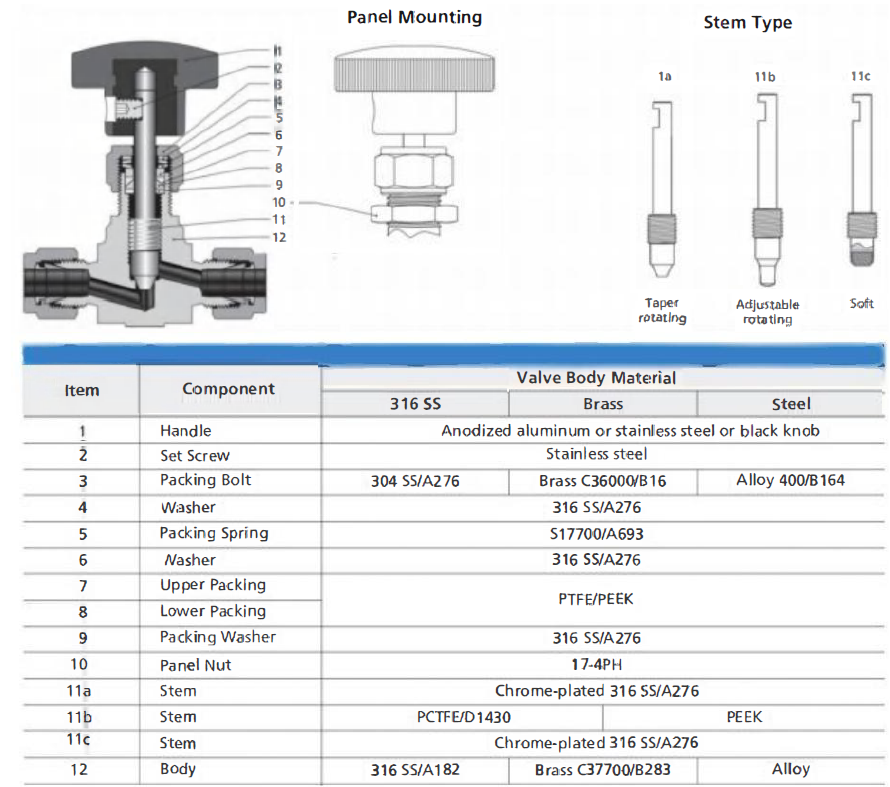
What Happens If Cv Is Wrong?
| If the Cv is too large | If the Cv is too small |
| Poor control accuracy | Insufficient flow capacity |
| Limited effective adjustment range | Cannot reach the required flow rate |
| Large flow changes from small adjustment | Restricts system performance |
Therefore, calculating the required Cv is the first step in selecting the right needle valve.
How to Calculate the Required Cv for a Needle Valve ?
Step 1: Collect Your Data
Collect basic data before calculating the required Cv. There is a little difference in data for separate media.
| Parameter | Liquid | Gas | Notes |
| Flow rate(Q) | ✓ | ✓ | GPM for liquid; SCFH for gas |
| Inlet pressure(P1) | ✓ | ✓ | For gas, use absolute pressure (psia) |
| Outlet pressure(P2) | ✓ | ✓ | Used to calculate ΔP |
| Pressure drop(ΔP) | ✓ | ✓ | ΔP = P1 — P2 |
| Specific gravity(SG) | ✓ | ✓ | water at 60 degrees F = 1.0; air at 70 degrees F and 14.7 psia = 1.0 |
| Temperature(T) | — | ✓ | Absolute temperature in degrees R. (degrees F + 460) |
Step 2: Plug Into the Right Formula
Select the appropriate Cv formula based on the fluid type.
- For liquids:Cv = Q × √(SG / ΔP)
Where:
Cv = required flow coefficient
Q = flow rate
ΔP = pressure drop across the valve
SG = specific gravity of the fluid
- For gases (subcritical flow, P2 > 0.5 × P1):Cv = (Q / 1360) × √(T×SG / (ΔP×(P1+P2)/2))
Where:
Q = gas flow rate (SCFH)
T = absolute temperature (°R = °F + 460)
SG = gas specific gravity (air = 1)
P1 = upstream absolute pressure (psia = gauge pressure + 14.7)
P2 = downstream absolute pressure (psia)
ΔP = P1 — P2 (psi)
Note: This formula covers most needle valve applications where the pressure drop is moderate. If your outlet pressure is very low (P2 ≤ 0.5 × P1), choked flow conditions may apply and a different equation is required. In such cases, consult the valve manufacturer.
For SI units (m³/h, bar), use the Kv coefficient:
Kv = Q × √(SG / ΔP) (Q in m³/h, ΔP in bar)
Kv = 0.865 × Cv
Step 3: Select Valve Size and Verify Cv
- Match Required Cv with Available Valve Cv
Select the needle valve which has a rated Cv slightly higher than the calculated Cv to ensure sufficient flow control. However, do not select a model with a rating far higher than required.
For example, if the calculated required Cv is 0.5:
| Needle Valve Size | Rated Cv | Selection Result |
| 1/4″ needle valve | 0.35 | Not enough flow capacity |
| 3/8″ needle valve | 0.56 | Suitable choice |
| 1/2″ needle valve | 0.70 | Higher capacity, but check control range |
The 3/8″ needle valve provides enough flow capacity while avoiding unnecessary oversizing. NPT-LOK válvulas de agulha provide different Cv values depending on the orifice size and valve connection size, allowing you to select the appropriate model based on their required flow capacity.
- Check the Valve’s Flow Range
Needle valves are used for flow control, so the valve should provide enough adjustment range under actual operating conditions.Before selecting the final valve, check if the required flow falls within the effective operating range shown in the manufacturer’s Cv data or flow curve.
- Confirm that the valve meets all operating condition requirements.
Verify the following points before making the final selection:
- Maximum operating pressure
- Temperature range
- Material compatibility
- Connection type
Common Mistakes
Even with the right formula, a few common errors can lead to a poorly sized valve.
- Selecting Valve Size Based Only on Pipe Size
Matching valve size to pipe diameter ignores Cv entirely. Two 1/2″ needle valves can have very different flow capacities. Always size by calculated Cv, not by pipe outer diameter.
- Using Incorrect Pressure Drop
ΔP means the actual pressure difference across the valve, not the pump discharge pressure or system design pressure. If you ignore downstream back pressure, you may get an overestimated ΔP and an undersized Cv.
- Ignoring Fluid Properties
Different fluids require different correction factors. Applying the water formula to oil will produce an incorrect result. Use the correct formula for your specific fluid.
- Using Wrong Gas Units
Gas calculations require absolute pressure (psia = gauge + 14.7) and absolute temperature (°R = °F + 460). Substituting gauge pressure directly into the formula causes large errors. Also confirm that your flow unit (SCFH, SLPM) matches the constant in the formula.
- Choosing Maximum Cv Instead of Required Cv
A larger Cv is not safer for flow control. It would compress the adjustment range and reduce precision. Choose a valve with a rated Cv moderately above the calculated value, not far above it.
| Mistake | Consequence | Correct Approach |
| Selecting Valve Size Based Only on Pipe Size | Cv mismatch | Size by calculated Cv |
| Using Incorrect Pressure Drop | Incorrect Cv result | Use actual ΔP across the valve |
| Ignoring Fluid Properties | Formula mismatch | Use the correct formula for your fluid |
| Using Wrong Gas Units | Large calculation errors | Use absolute pressure and temperature |
| Choosing Maximum Cv | Lost control precision | Choose moderately above calculated Cv |
Summary: Cv Sizing in Four Steps
- Gather: Flow rate, pressure drop, specific gravity, and temperature.
- Calculate: Plug the values into the formula to determine the minimum required Cv.
- Scale up: Select a valve with sufficient capacity and suitable adjustment range.
- Verify: Check for special operating conditions and consult the manufacturer if necessary.
Perguntas frequentes
Q1:How does a needle valve work?
A threaded stem moves a tapered needle in and out of a small seat opening; the fine threads allow tiny adjustments, giving precise control over flow.
Q2:How to choose the right type, material,and connection after calculating Cv?
Cv determines the required flow capacity. But you still need to decide on body type, pressure rating, material, packing, and thread standard. If you want to learn more about this, move to Needle valves types and selection guide
Q3:Why does my needle valve lose flow control even after Cv calculation?
The main reason is a mismatch between the calculated Cv and actual operating conditions.Please check whether any of the common errors mentioned above occurred during the calculation process.
Q4:What if my operating conditions change after installation?
You need to recalculate Cv based on new parameters after operating conditions change. However, you could continue to use it if the rated Cv of the existing valve allows the target flow rate to fall within the 30%–70% opening range. If the valve is oversized or undersized, please replace it as early as possible.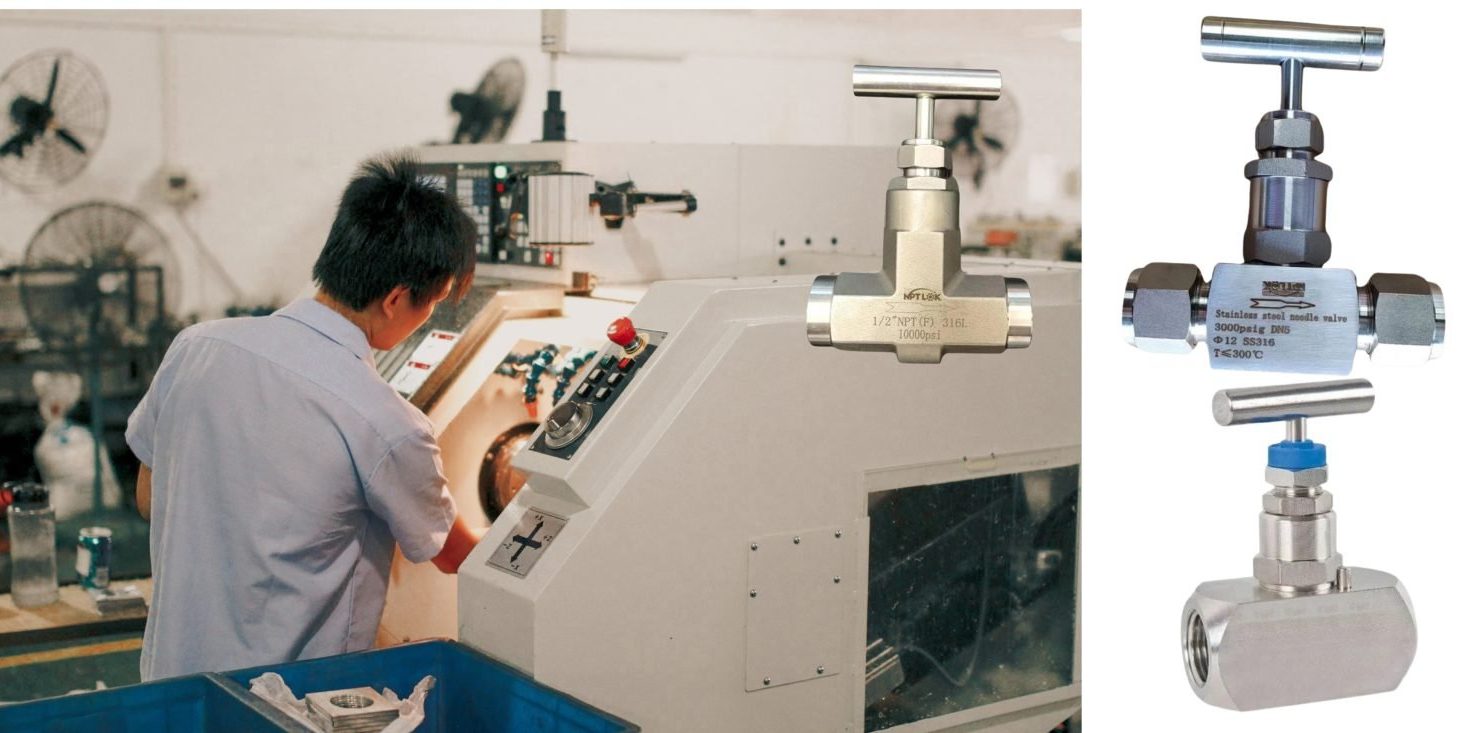
We Make Needle Valves
NPTLOK is a manufacturer of needle valve for more than 20 years with good quality, competitive prices, and mature technology.
We provide:
Size Range: 1/8″ to 1″ (3 mm to 25.4 mm)
Pressure Rating: 3,000 psi to 10,000 psi
Connection Types: Female NPT, Male NPT, BSPP, Metric threads, tube ends, butt weld, socket weld, and flange connections
Packing Options:
- PTFE packing for temperatures from -54°C to 232°C
- Graphite packing for high-temperature service up to 469°C
Needle Valve Types:
- Válvulas de agulha de virola dupla
- Male & Válvulas de agulha de rosca fêmea
- Flange Needle Valves
- Butt Weld & Socket Weld Needle Valves
- Block and Bleed Needle Valves
Choose needle valve types according to your requirements.