


Search “boquilla hexagonal price” and you’ll get pages of product listings and price tags. Prices range from a couple of bucks to a few hundred—but you’ll seldom see an explanation for the huge differences. Here’s why.
Factors That Make Hex Nipple Prices Different
Material
The material is where most of the cost comes from.
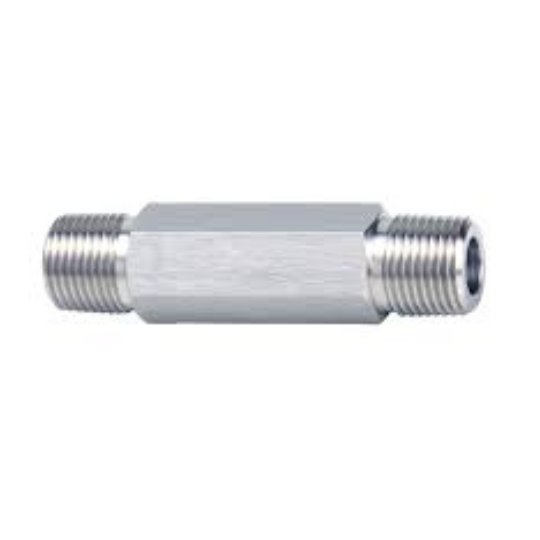
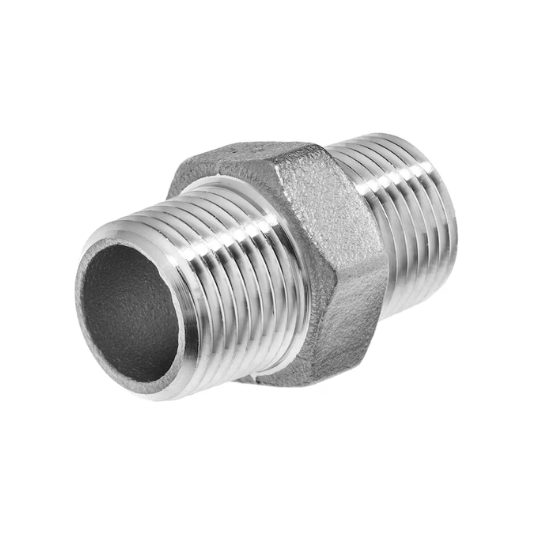
Take 316 and 304 stainless steel. 316 has molybdenum in it—that’s what makes it stand up to salt water, chlorides, and chemical exposure. Marine environments? Chemical plants? 316 is your answer. But better corrosion resistance comes with a bigger price tag. 316 costs noticeably more than 304.
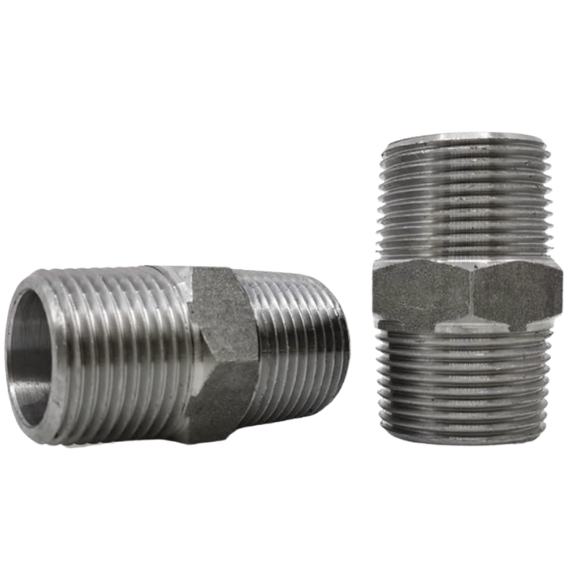
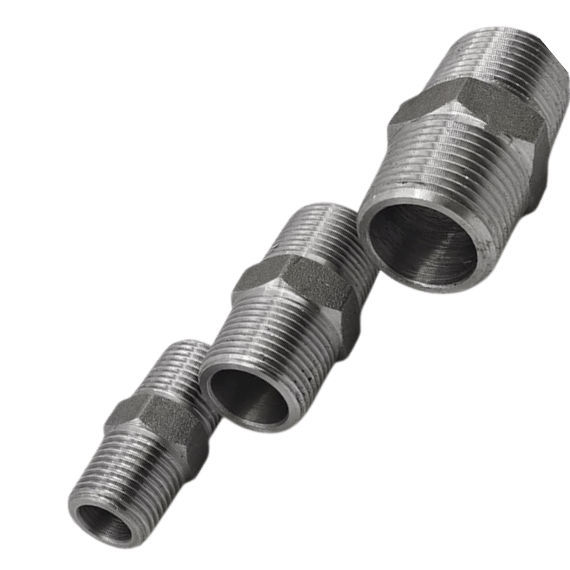
Carbon steel is the cheapest option. Strong enough for most jobs, works fine in dry, indoor settings. But it rusts the moment you expose it to moisture or acids—unless you coat or plate it. ASTM A105 is the most common grade you’ll run into.
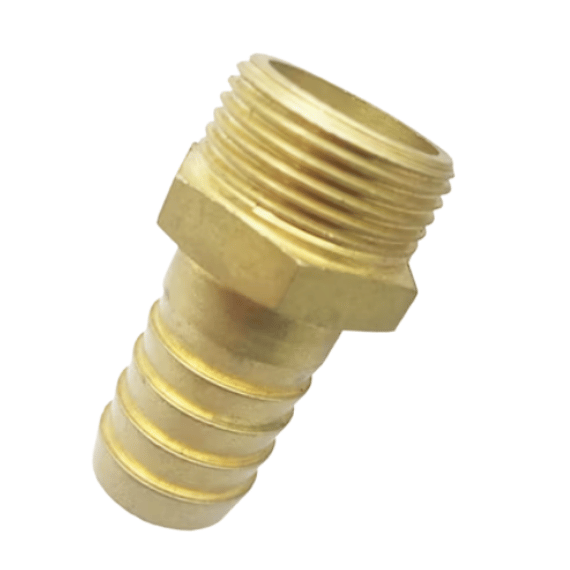
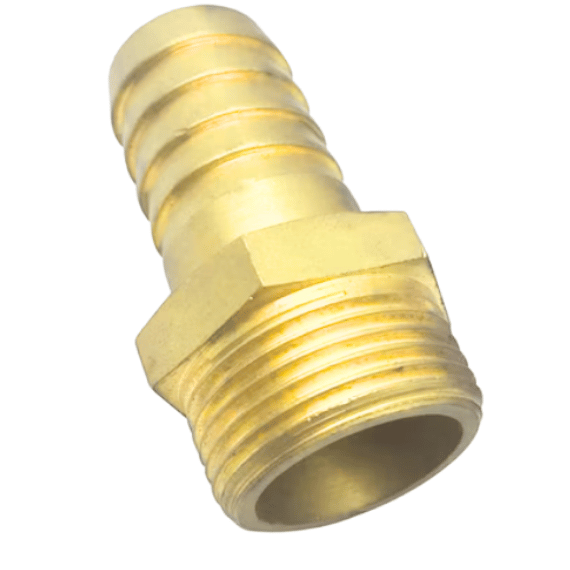
Latón sits in the middle. Cheaper than stainless, pricier than carbon steel. Air lines, low-pressure water systems—brass handles them well and machines easily.
Galvanized or zinc-plated steel is basically carbon steel with a rust-resistant coating. Adds some protection without breaking the bank. Think of it as carbon steel with a raincoat.
Specialty alloys like duplex stainless, Inconel, Monel, or Hastelloy? Those are for the tough stuff. Extreme heat, seawater, aggressive chemicals—when nothing else works, you look at these.
Typical price ranking, same size and spec: carbon steel (galvanized included) < brass ≈ 304 stainless < 316 stainless. Brass and 304 prices often overlap depending on market conditions, while 316 can run 30% to 80% higher than 304.
Pipe Size
Pipe size (the nominal bore diameter) directly affects how much raw material goes into each piece. A 1″ fitting uses far more steel than a 1/8″ fitting, and the price scales accordingly.
A reducing hex nipple costs more than a straight one, because it requires extra machining setups and more complex handling. That added labor adds up.
Hex Size
The width across the flats of a hexagon affects the price in two main ways.
First, raw material and machining. A larger hex means you start with a thicker bar of steel. More material in, more cost. And since there’s more metal to remove on the lathe, the machining takes longer too.
Second—and this one’s easy to miss—sealing on BSPP threads. BSPP (British Standard Pipe Parallel) threads use a parallel G thread to ISO 228—the thread itself is not tapered and does not seal by thread engagement. BSPP connections require a face seal—typically a Dowty washer (a bonded seal with a metal outer ring and an elastomer ring bonded to the inside diameter).
Here’s where hex size matters: the Dowty washer needs a flat shoulder behind the thread to seal against. On BSPP male threads, the sealing surface is the machined shoulder, not the hex itself. Standard BSPP fittings are designed to match standard bonded washers. If your application requires a larger washer, you may need a custom shoulder or larger hex, which adds cost.That becomes a real headache on fixed ports where you can’t change the port design.
Most standard hex nipples on the market follow common hex sizes that may not accommodate a Dowty washer. If your application needs one, the manufacturer has to customize a larger hex. That means no standard dies, extra machine setup, slower production—and a higher per-unit price.
Dowty washer sizing reference:
| BSPP Thread Size | Inner Diameter (mm) | Outer Diameter (mm) |
| 1/8″ BSPP | 8.8 | 14.3 |
| 1/4″ BSPP | 11.9 | 18.0 |
| 3/8″ BSPP | 15.2 | 21.8 |
| 1/2″ BSPP | 19.1 | 26.5 |
| 3/4″ BSPP | 24.6 | 32.5 |
| 1″ BSPP | 30.5 | 39.5 |
The hex size must be large enough to accommodate the washer’s outer diameter. Always check your hex size against the washer you plan to use.
Length
Length and material consumption go hand in hand—more length, more steel.
Moreover, a long, slender nipple is harder to machine. It flexes under cutting pressure, so the lathe has to run slower to hold tolerances. That adds time to every piece. Shipping also costs more because dimensional weight goes up. So the price difference between a 2″ nipple and a 12″ nipple is bigger than just the extra steel.
Clasificación de presión
Pressure rating affects price for a simple reason. Higher pressure requires thicker walls. Thicker walls mean more material and longer machining time.
On the low end, you’ve got 150 psi systems—air lines, cooling water, general plumbing. Standard wall thickness handles that just fine. But when you move into high-pressure territory—hydraulics, oil and gas—you’re looking at 3000 psi or 6000 psi, which means stepping up to Sch 80/XS or even Sch 160 wall thickness. Go higher still—10000 psi test stands—and you’re into XXS or custom-heavy walls, with tougher material grades and stricter testing to match. Every step up in wall thickness adds material cost and machining difficulty, and the price moves right along with it.
Quantity & Customization
Quantity: Setup costs—tooling, programming, machine warm-up—are fixed per production run. For small batches, these costs are spread across fewer pieces, raising the per-unit price. Large production runs lower the per-unit cost.
Customization: Non-standard lengths, special hex sizes, uncommon thread combinations, or exotic materials all require deviation from standard production. This means additional tooling or custom dies, longer setup and programming time, slower production speeds, and sometimes minimum order quantities. All of these add to the final price.
Thread Type & Machining Method
Many manufacturers charge different prices for different thread types. NPT, BSPP, and BSPT may require separate tooling, inventory, or production runs. Rolled threads—though stronger and more fatigue-resistant—typically cost more than cut threads because of higher tooling investment.
At NPTLOK, we do not add cost for thread type or machining method. NPT, BSPP, and BSPT are priced the same. Rolled threads—our standard—are also the same price as cut threads. You get the performance benefit without the extra charge.
Preguntas frecuentes
Q1. What is the difference between BSPP and BSPT threads?
BSPP (G thread) is parallel and seals with a face seal (bonded washer or O-ring). BSPT (R thread) is tapered and seals on the threads, usually with PTFE tape. Both have a 55° thread angle, but they’re not interchangeable.
Q2. Can I use any hex nipple with a Dowty washer for BSPP connections?
No. The hex has to be wide enough to give the Dowty washer a solid bearing surface. The washer needs a machined flat surface to seal against. If the hex is too narrow, the washer won’t seat properly and won’t seal. Always check your hex size against the washer’s outer diameter.
Q3. Does extra length affect the pressure rating?
No. The pressure rating depends on wall thickness, material, and design standard, not length. Longer nipples may need extra support in vibrating systems, and they cost more to machine, but length itself does not lower the pressure rating.
Q4. What is the most cost-effective material for corrosive environments?
316 stainless steel. It costs more than 304 upfront, but it lasts much longer in saltwater or chemical environments. Over the full lifecycle, it usually works out cheaper than replacing 304 fittings every few years.
Q5. What are the different types of hex nipples?
Common types include standard, long, reducing, and special pipe nipples. See our hex nipple types guide for full details on each type, materials, and thread options.
Contáctenos
NPTLOK is a precision pipe fitting manufacturer serving instrumentation, hydraulic systems, chemical processing, oil & gas, and power generation industries worldwide.
Our manufacturing facility is ISO 9001:2015 certified, and we operate both bar-stock and forging production lines to ensure full in-house quality control. Critical products undergo 100% pressure testing before shipment. Every fitting is marked with the NPTLOK manufacturer name for full traceability, and all male threads are capped for protection during shipping and storage.
All external threads on NPTLOK hexagonal fittings are NPT standard rolled threads.
Descargar Our Catalog
Learn more sobre nosotros


