


Pipe nipples come in several styles, including hex, long hex, close, barrel, shoulder, reducing, swage, and weld nipples, each with its own design and use. If you’re comparing different types of pipe nipples, this guide covers the main types, key differences, and typical applications.
8 Common Types of Pipe Nipples
Pipe nipples are often grouped by their appearance. Some names refer to body shape, such as hex and barrel nipples. Others describe the distance between the threaded ends, the sizes of the connections, or how the ends are prepared.
These categories can overlap. For example, a reducing hex nipple has both a hexagonal wrenching section and different connection sizes at its ends.
| Type | Key Feature | Typical Use | What to Confirm |
| Hex nipple | Male threads at both ends with a central hex for wrench access | Connecting female-threaded components where wrench access is needed | Thread standard and size at each end |
| Long hex nipple | Extended body with a wrenching hex | Adding clearance between valves, instruments, or fittings | Overall length and installation clearance |
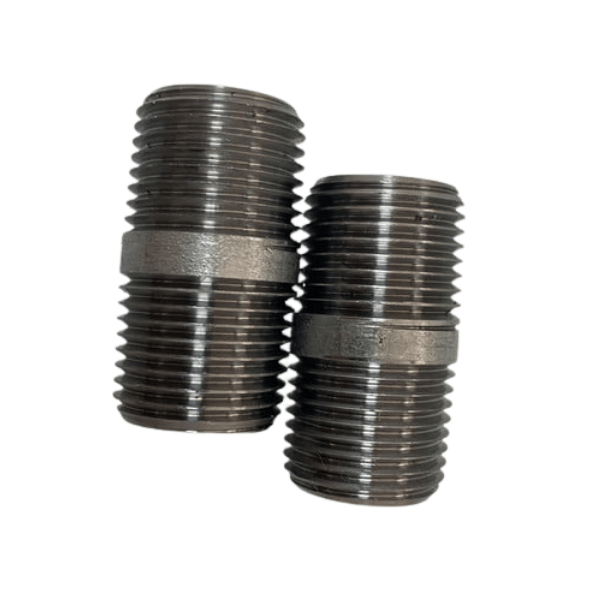
| Close nipple | Threads cover nearly the entire length | Making compact connections between female-threaded fittings | Thread engagement and installation tool access |
| Barrel nipple | Male-threaded ends with a round, unthreaded middle section | Connecting components with a specified separation | Overall length and wall thickness |
| Shoulder nipple | Short unthreaded section between threaded ends | Providing a short connection with some unthreaded body length | Supplier dimensions and required spacing |
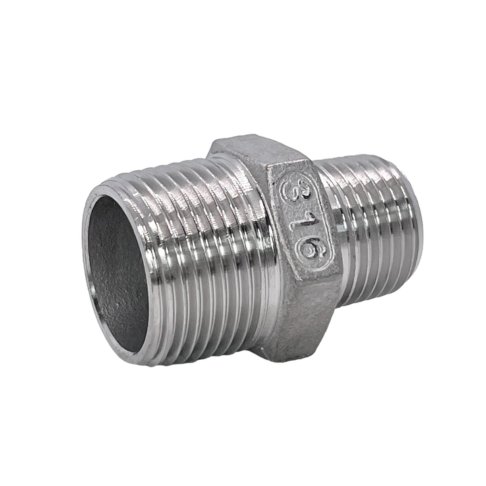
| Reducción del pezón | Different nominal connection sizes at each end, often with a hex body | Joining female-threaded ports of different sizes | Both connection sizes and thread standards |
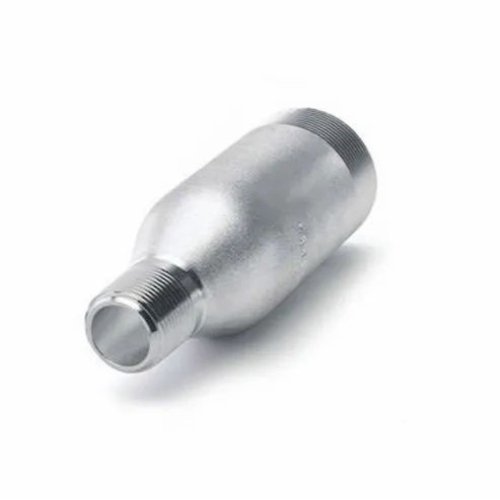
| Swage nipple | A concentric or eccentric tapered transition between different diameters | Connecting piping sections of different diameters | End preparation, dimensions, and concentric or eccentric configuration |
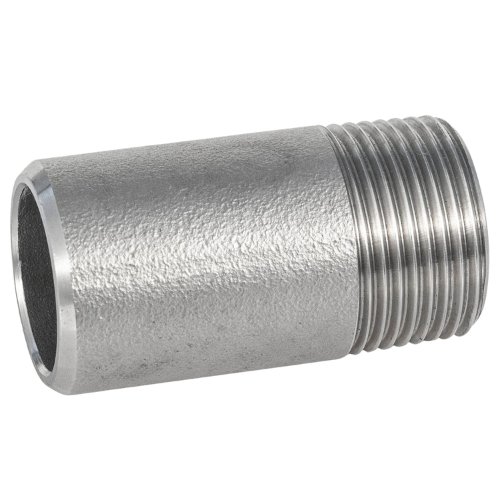
| Weld nipple | Includes a weld end; a common configuration has threads at the other end | Connecting a threaded component to welded piping | Weld-end preparation and mating connection requirements |
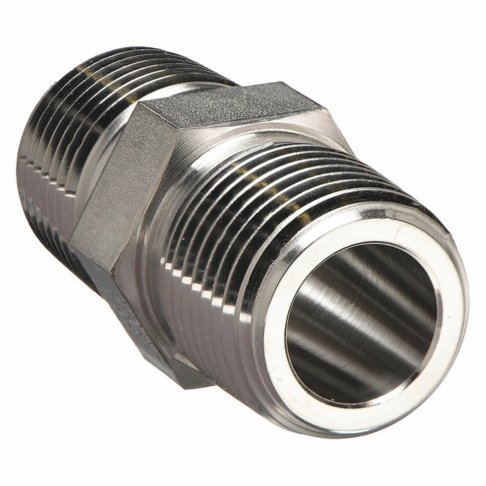
Boquilla hexagonal
A hex nipple has male threads on both ends. The middle is hexed, so a wrench can grab it and tighten or loosen the fitting. You’ll see it used with female-threaded valves, pressure gauges, and other pipe fittings. Both ends may be the same size, or they may differ. If they differ, it’s usually called a reducing hex nipple.
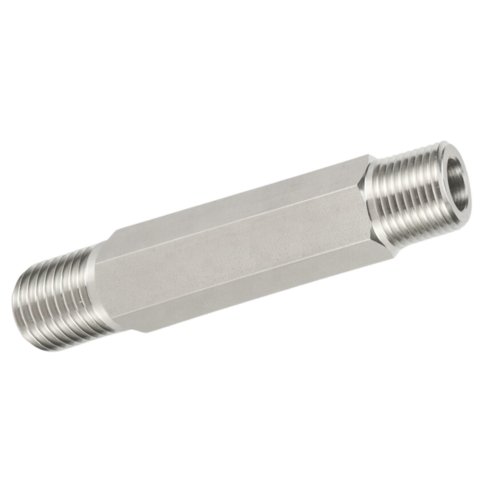
Long Hex Nipple
Same idea as a hex nipple, just longer. Male threads on both ends, hex in the middle for a wrench. The longer body buys you space between parts. Need a pressure gauge mounted farther from a valve or want room for insulation and tools, this is the one you’d use.
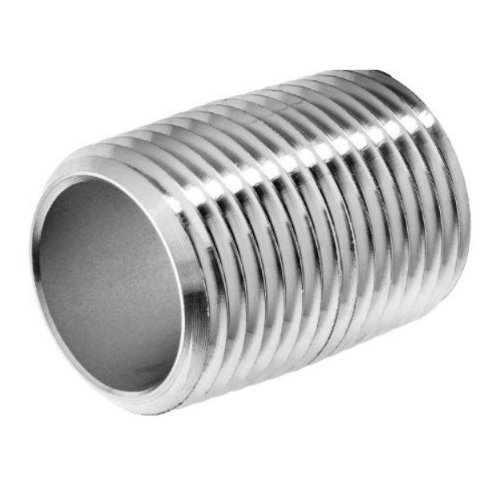
Close Nipple
A close nipple is threaded almost all the way across. There’s little or no smooth section in the middle. Some suppliers call it a running nipple. It lets two female-threaded fittings sit close together, which helps in tight spaces. The trade-off is that there’s not much for a wrench to grab, so tightening it can be a pain.
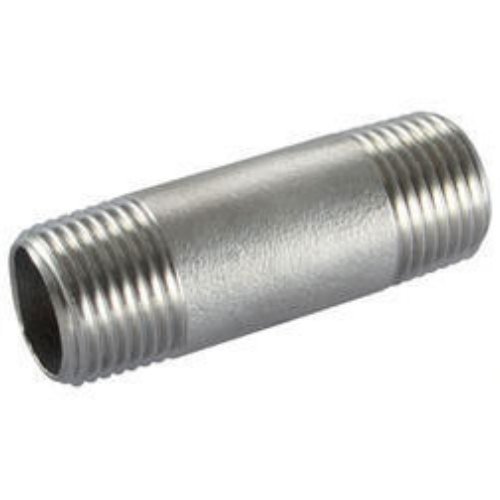
Barrel Nipple
This is probably the one you’ve seen most. Male threads on both ends, smooth round section in the middle. It connects or extends threaded pipe in plumbing, water distribution, and industrial piping. They come in different lengths, so you can match the gap you’re working with.
Shoulder Nipple
A shoulder nipple looks like a barrel nipple, except the unthreaded middle is much shorter. It gives you a small gap between fittings without adding a barrel nipple’s extra length. And unlike a close nipple, that short smooth section is still visible after installation.
Also called an unequal nipple or reducer nipple. Each end has a different nominal thread size. It joins female-threaded ports that don’t match—1/2 inch to 1/4 inch, for example. Many have a hex body so a wrench can grab them.
Swage Nipple
A swage nipple has a tapered body. It connects pipes of different diameters.
Concentric swage nipple: Both ends share the same centerline, so the transition is symmetrical.
Eccentric swage nipple: The centerlines are offset, leaving one side flat. This is used when the piping layout calls for an offset transition.
Ends can be threaded, plain, or beveled, depending on the connection.
Weld Nipple
A weld nipple—sometimes called a welding nipple—connects threaded parts to welded piping. A common design has male threads on one end and a weld end on the other. They’re usually made from stainless steel or carbon steel. You’ll use them in industrial piping, including oil and gas systems.
Pipe Nipple End Types and Connection Configurations
Pipe nipples are also identified by their end connections. The following abbreviations describe how each end is prepared.
| Abbreviation | Full Term | Description |
| TBE | Threaded Both Ends | Both ends are threaded |
| TOE | Threaded One End | One end is threaded |
| PBE | Plain Both Ends | Both ends are plain |
| BBE | Beveled Both Ends | Both ends have beveled edges |
| TLE | Threaded Large End | The larger end is threaded |
| TSE | Threaded Small End | The smaller end is threaded |
| PLE | Plain Large End | The larger end is plain |
| PSE | Plain Small End | The smaller end is plain |
TBE is common for standard threaded pipe nipples. Other configurations are found in swage nipples and piping connections involving welding.
For example, PLE/TSE describes a swage nipple with a plain large end and a threaded small end. When ordering a nipple with different end connections, specify the preparation of both ends to avoid mismatched fittings.
How to Choose the Right Pipe Nipple Type
Before you pick a nipple, check both ports. Two female ports, different sizes? A reducing nipple fits. Pipes with different diameters? Go with a swage nipple. Then confirm the thread standard—NPT, BSPT, BSPP, whatever the mating parts use.
Nominal size by itself won’t tell you if they’ll mate. Pipe nipple length matters too. A close nipple keeps things tight. A barrel nipple or long hex nipple gives you more spacing. Just keep in mind that the listed overall length includes the threaded ends, so once installed, less of it will show. Wrench access is another thing. Hex nipples have flats you can grab. Close and shoulder nipples don’t leave much room, which gets tricky in compact instrument setups. And don’t skip material and ratings: match them to the fluid and service environment, then check bore, wall thickness, and pressure-temperature rating.
Preguntas frecuentes
Q1. What materials are pipe nipples made of?
Pipe nipples are commonly made from stainless steel, carbon steel, and brass. Specialty alloys such as Monel and super duplex stainless steel are also used for applications requiring greater corrosion resistance.
Q2. What is the difference between a reducing nipple and a swage nipple?
A reducing nipple connects two female-threaded ports of different sizes, often with a hexagonal body. A swage nipple has a tapered body for transitioning between pipe diameters and may feature threaded, plain, or beveled ends.
Q3. What are the standard sizes of pipe nipples?
Pipe nipples commonly range from 1/8 to 4 inches in nominal pipe size, though available sizes vary by type and manufacturer. You should confirm the thread size, overall length, and wall thickness before ordering.
Q4. How long is a close pipe nipple?
Close nipples are among the shortest pipe nipples, with threads covering nearly their entire length. Their exact dimensions depend on the nominal pipe size and applicable specifications. Check the manufacturer’s dimensional chart for accurate measurements.
Q5. How to tighten a close pipe nipple?
You can use an internal nipple wrench that fits the nipple’s bore to tighten it without damaging the external threads. Apply the appropriate tightening method and avoid excessive force, which could damage the fitting or connection.
Q6. What types of pipe nipples do you supply?
NPTLOK supplies hex nipples, long hex nipples, close nipples, and special pipe nipples. We offer various thread sizes, lengths, and material options, including stainless steel, carbon steel, and brass. Contact us for specific configurations and availability.
Contáctenos
NPTLOK’s pipe nipple includes hex nipples, long hex nipples, close nipples and special pipe nipples, with dimensions and material-dependent ratings for the listed configurations.
Materials we commonly use include acero inoxidable, carbon steel, latón, and other special materials including Monel, Alloy, Super Duplex, and so on.
If you require carbon steel material, we will do galvanizing on the surface of pipe nipples. If you require brass pipe nipple, we will make the chrome-plated treatment on the surface of brass pipe nipples.
Learn more sobre nosotros or download our catalogar.
Send us your connection sizes, thread standards, required length and operating conditions. We can help identify a suitable catalog configuration for your assembly.


