


Choosing between a Kugelhähne Und Nadelventil ?
Here’s the short answer: Use a ball valve for quick on/off isolation. Use a needle valve for precise flow regulation. They are not interchangeable. This guide breaks down the 5 key differences: operation, flow path, pressure rating, temperature limits, and application, so you can make the right choice for your system.
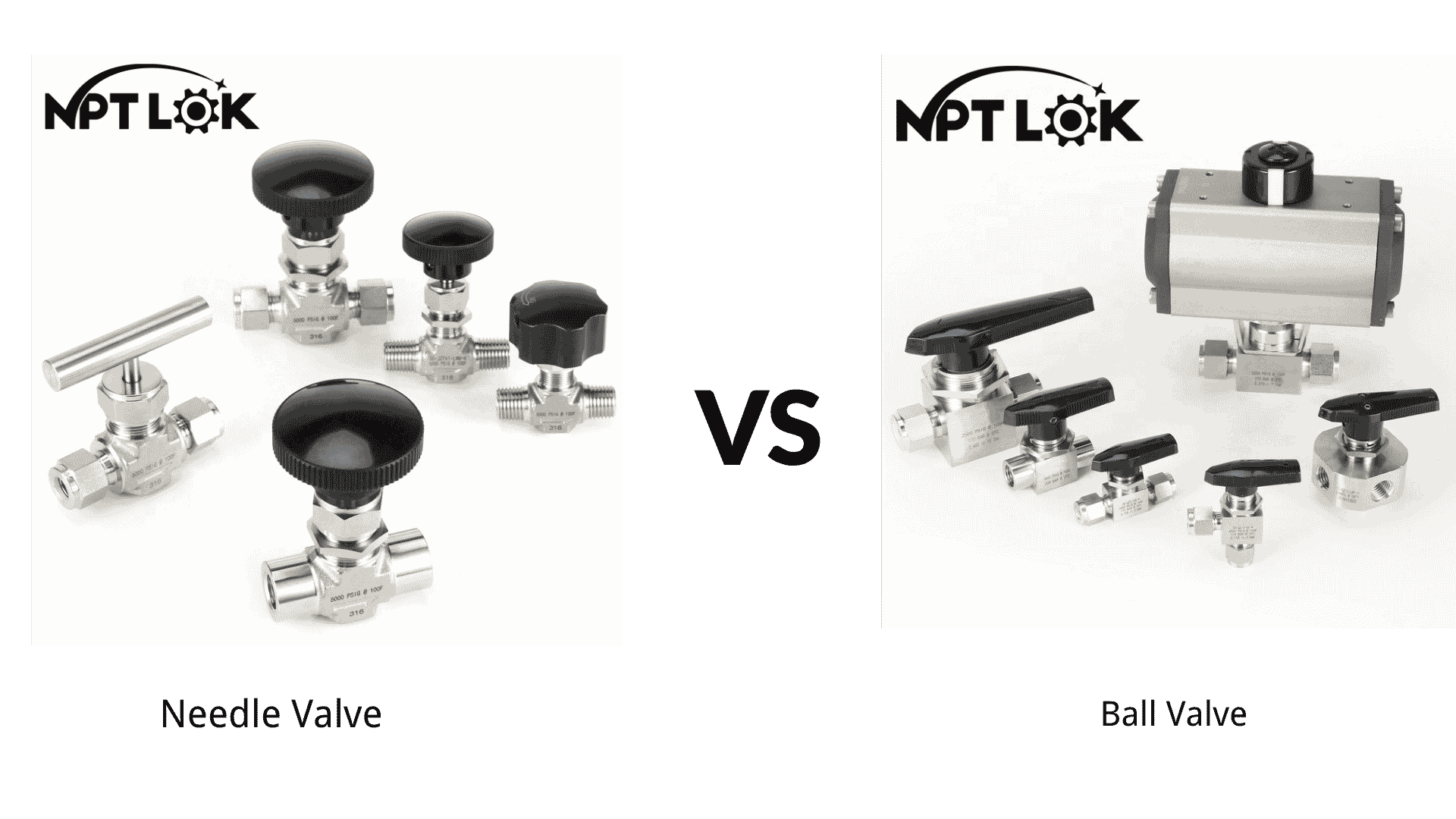
Ball Valve vs Needle Valve: Core Difference at a Glance
| Ball valve | Nadelventil | |
| Primary Function | Quick on/off isolation | Precise flow regulation |
| Operation | Quarter-turn (90°) | Multi-turn |
| Flow Path | Full bore, minimal pressure drop | Restricted, high pressure drop |
| Best For | Emergency shutoff, sampling systems, instrument air isolation | Metering, chemical injection, high-pressure analyzer panels |
| Throttling | Not recommended | Designed for it |
Bottom line: Choose a ball valve when you need to stop or start flow fast. Choose a needle valve when you need to control how much flows through.
What is a Ball Valve (Instrumentation Ball Valve)?
An instrumentation ball valve is a compact shutoff valve, used on instrument panels, analyzers, and sampling systems. It’s not the same as the large industrial ball valves you see on pipelines. Those are big; these are small, made for tight spaces. There’s a ball inside with a hole straight through it. Align the hole with the pipe, fluid flows. Turn it 90°, the hole faces across the pipe, flow stops.
Flow control is not recommended for ball valves. They are designed for quick shutoff, not throttling.
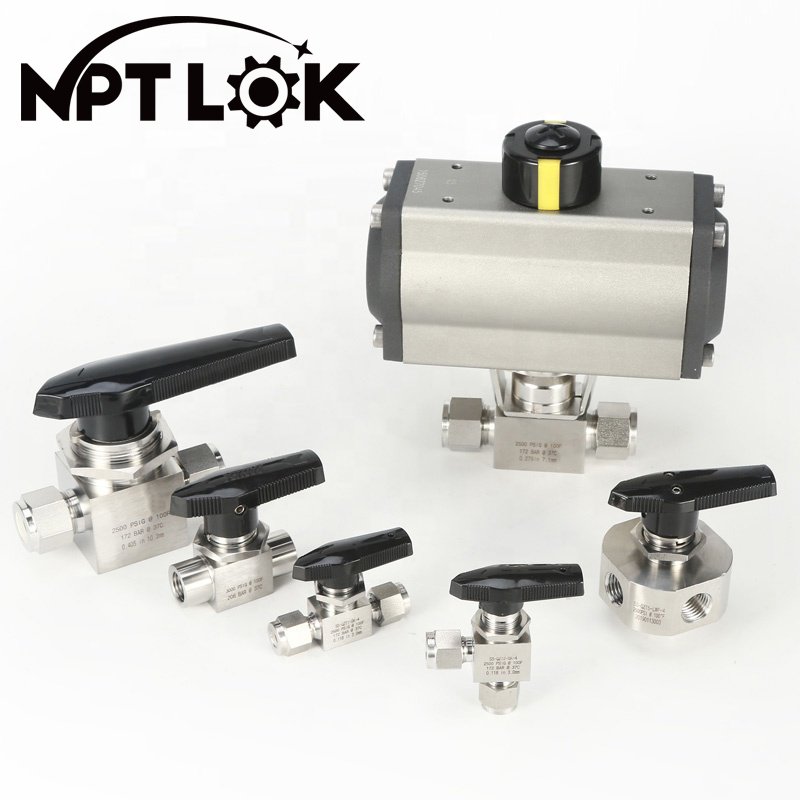
Key Features of Ball Valve:
- Compact, space-saving design — ideal for instrument panels and skid-mounted systems
- Quarter-turn operation — fast, positive shut-off
- Bi-directional flow (straight valve patterns)
- Top-entry design — allows in-line inspection and repair without removing the valve from the system
- Bubble-tight shutoff — every valve is leak-tested with nitrogen at maximum working pressure
- Multiple configurations — 2-way, 3-way, angle, and crossover (4-way, 6-way)
- Ball design options — floating ball or trunnion ball for different pressure requirements
- Handle color options — available for easy identification
Applications: Instrumentation air isolation, gas/liquid sampling systems, high-pressure hydraulic systems, panel mounting, drain and vent applications
What is a Needle Valve?
The needle valve is the most typical type of an instrument valve. The design principle involves using a sharp, needle-shaped plug that, through rotation or movement, adjusts the size of the passage through which fluid flows through the valve, thereby controlling the flow rate.

Key Features of Needle Valve:
- Multi-turn operation — precise flow regulation
- Non-rotating stem design — prevents galling damage to the seat and tip
- Multiple packing options — PTFE, PEEK, or graphite for different temperature ranges
- Bubble-tight shutoff — every valve is leak-tested with nitrogen at maximum working pressure
- Panel mounting — available as an option
- Safety back seating — available on select series (fully open position)
- Replaceable seats and stem tips — available on select series for extended service life
- Handle color options — available
Applications: Instrumentation systems, gas metering in laboratories, and hydraulic systems
Critical differences between Ball Valve and Needle Valve
Technical Comparison Table
| Feature / Metric | Kugelhahn | Nadelventil |
| Flow Coefficient (Cv) | High Cv (Minimal pressure drop) | Low Cv (Higher flow resistance) |
| Primary Seal | Soft seat (PTFE, PEEK, modified PTFE, etc.) | Soft seat (PTFE, PEEK) or graphite packing standard; metal-to-metal also available |
| Temperature Limit | Standard series up to 232°C (450°F); some series up to 148°C (300°F) | PTFE up to 232°C, PEEK up to 260°C, Graphite up to 649°C (1200°F) |
| Low-Temperature Suitability | With appropriate low-temp seal material (e.g., modified PTFE, PCTFE), maintains elasticity and low torque down to -50°C and below; ideal for frequent on/off | No organic embrittlement, but metal thermal contraction may increase torque; very reliable with proper design |
| Pressure Range | Instrument class commonly rated to 6000 psi; floating ball with soft seat gives bidirectional bubble-tight shutoff | Routinely up to 10,000 psi and beyond; metal cone seal withstands high differential pressure |
| Operation | Quick quarter-turn open/close; not suitable for throttling | Multi-turn precise flow regulation; can be used for shutoff but slow |
| Flow Path | Full bore, minimal pressure drop | Restrictive flow path, high-pressure drop — useful for metering |
| Typical Application Scenario | Low-temperature drains/vents, sampling systems needing fast positive shutoff, instrument air isolation, flammable gas shutoff | High-temperature steam sampling, high-pressure analyzer panels, chemical injection with fine flow control |

How to Choose Between a Ball Valve and a Needle Valve?
You may already be aware of the differences between ball valves and needle valves. Armed with this knowledge and the specific requirements of your application, it should not be difficult to determine whether a ball valve or a needle valve is the best choice for you.
Step 1: Matching Operation Methods and Functions
If you need a quick on-off valve, Choose a ball valve. Quarter-turn operation provides fast shutoff, making it ideal for emergency isolation and frequent cycling.
If you need precise flow regulation, Choose a needle valve. Multi-turn operation allows fine control, making it ideal for metering and throttling.
Step 2: Ensure an adequate safety margin for the pressure rating
Pressure ratings vary significantly among different valve series, taking the NPT-LOK product as an example:
| Valve Type | Series | Maximum Working Pressure |
| Instrument Ball Valve | HBB Hex Bar Stock Ball Valve | 2000 psig (138 bar) |
| OIB One-piece Instrument Ball Valve | 3000 psig (207 bar) | |
| HPB High Performance Ball Valve | 6000 psig (414 bar) | |
| TB Standard Trunnion Ball Valve | 6000 psig (414 bar) | |
| Nadelventil | BN Integral Bonnet Needle Valve | 3000 psig (207 bar) |
| BNH High Pressure Integral Bonnet Needle Valve | 5000 psig (345 bar) | |
| FN Integral Forged Needle Valve | 6000 psig (414 bar) | |
| FNH Ultra High Pressure Forged Needle Valve | 10000 psig (689 bar) |
Never undersize a valve’s pressure rating just to save cost. Take a 1000 psig ball valve in a 2000 psig system — it’s a serious safety hazard. Conversely, running a high-pressure valve continuously at low pressure can also reduce seal life.
Keep in mind: Pressure ratings are temperature-dependent. Always refer to the pressure-temperature curve for the specific series — as temperature goes up, maximum working pressure comes down.
Step 3: Temperature Range and Media Compatibility
Valve temperature limits come down to the materials:
PTFE seals – max around 204°C. Chemically inert, works with most media.
PEEK seals – max above 230°C. High strength and rigidity, good for demanding processes.
FKM (fluorocarbon) seals – max around 204°C. Handles heat and oils well, but don’t use it with strong acids or bases.
Graphite packing – exceeds 400°C. Resists aggressive corrosion, designed for high-temperature service.
Special note for oxygen or high-purity gas systems: you must use an oil-free, cleaned valve version (model numbers usually include “OF”). Residual grease can cause explosions or contamination — it’s a serious safety risk.
Step 4: Interface Type and Ease of Maintenance
Common connection types on our valves include:
Rohrverschraubungen (for stainless steel tubing)
Threaded ends (NVV or BSP)
Weld ends (socket weld or butt weld)
Flanged ends
Before installation, always double-check:
Thread type – NPT vs BSP, male vs female – they are not interchangeable.
Tube fitting size – metric vs imperial – make sure they match your tubing.
Get this wrong, and you’ll end up with mismatched connections or need adapters on site — both introduce extra leak points.
Maintenance tip: If your system needs to keep running while you service or replace valve internals, consider a 3-piece ball valve or a union bonnet needle valve. These designs allow quick access to the seat or packing without breaking the pipe connections on both sides, minimizing downtime.
Häufige Fehler
-
Frequent, rapid opening and closing of the needle valve
| Symptom | Grundursache | Lösung |
|---|---|---|
| Das Betriebsdrehmoment nimmt mit der Zeit zu | Gewindeverschleiß durch wiederholtes Hochgeschwindigkeitsfahren | Zyklusfrequenz reduzieren; Kugelventil für Anwendungen verwenden, die häufiges Ein- und Ausschalten erfordern. |
| Das Ventil schließt nicht blasenfrei. | Konischer Stopfen und Sitzflächen durch direkten Aufprall beschädigt | Ventilsitz und Spindelspitze ersetzen (bei der NPT-LOK-Serie verfügbar); falls nicht austauschbar, das gesamte Ventil ersetzen |
| Unregelmäßige Durchflussmessung stromabwärts | Sitzverformung durch wiederholte Stöße | Wechseln Sie zu einem Mehrgang-Nadelventil mit nicht rotierender Spindel. |
-
Ignoring the maximum allowable pressure differential
Frage 1: Kann ein Kugelhahn als Regelventil verwendet werden?
Im Allgemeinen nein. Kugelventile sind für die Absperrung ausgelegt. Ihre Verwendung zur Drosselung führt zu schnellem Verschleiß des weichen Ventilsitzes, was Leckagen und eine verkürzte Lebensdauer zur Folge hat. Für Durchflussregelungsanwendungen verwenden Sie ein Nadelventil.
Frage 2: Gibt es Probleme, wenn Hochdruckventile in einem Niederdrucksystem verwendet werden?
Technisch gesehen ja. Zu berücksichtigen sind jedoch: höheres Betriebsdrehmoment (ausgelegt für Hochdruckabdichtung), höhere Kosten, potenzielle Dichtungsunterschiede bei niedrigen Drücken und größere Abmessungen.
Frage 3: Warum fühlt es sich an, als würden manche Nadelventile nach längerem Gebrauch nicht mehr richtig schließen?
Die konische Oberfläche kann durch Partikel zerkratzt werden, durch Rotationsreibung Rillen entwickeln oder sich durch wiederholte Stöße verformen und verbreitern. Viele NPT-LOK-Nadelventile verfügen über austauschbare Ventilsitze und Spindelspitzen – der Austausch dieser Komponenten stellt die absolute Dichtheit wieder her, ohne dass das gesamte Ventil ausgetauscht werden muss.
Kontaktieren Sie uns
Unsere Instrumentenventile (Nadelventile, Kugelventile) werden geliefert in Edelstahl oder anderen Speziallegierungen. Wir bieten eine Vielzahl von Anschlussmöglichkeiten für Instrumentenventile, darunter NPT-, BSP- und metrische Gewindeanschlüsse. Die Größen reichen von 1/8" bis 1", und alle Komponenten sind vollständig rückverfolgbar. Für jede Charge von Instrumentenventilen wird ein Materialprüfzeugnis (MTC) ausgestellt.
Kontaktieren Sie uns Wir besprechen mit Ihnen Ihre spezifischen Anwendungsanforderungen, einschließlich Druck, Temperatur, Medium und Funktion, und helfen Ihnen, das richtige Ventil für Ihre Anwendung zu finden.
Mehr erfahren über uns.


