


Needle valves are typically classified into several types, which are utilized for particular functions. And you may want to know what features you need to take into account when choosing one. Here is a brief introduction of each type and a selection guide.
- Main Types of Needle Valves
Straight Needle Valve.
This type of needle valve is the most general-purpose type of needle valve and is normally the first choice for the majority of applications as it is simple to use. The straight type of needle valve has an inlet connection and an outlet connection in a straight line.
Angle type Needle Valve
It has the inlet and outlet connection port angles of 90°. It can be mounted directly on a flat surface. It can also be recessed and installed flush with a panel. In many situations, such as those where space is at a premium, angle type needle valves can save a lot of space where the pipes are at right angles.
It is generally made of thick-walled materials, to withstand high pressure, and is commonly used in hydraulic systems, high pressure gas systems, and in the oil and gas field.
It is also available in very small dimensions for use in instrument control panels, laboratory applications or as an additive to a chemical reactor. These precise control valves are available for very small flow rates of liquids or gases.
Multi-port Needle Valve
It is designed with one inlet and two or three outlets. A multi-port needle valve is used to feed a pressure gauge, a pressure switch and a transmitter from one single process connection. This valve is very space saving on crowded panels.
It is a valve which contains one or more needle valves. They are offered in 2, 3 and 5 port variations. As the manifold type of valve is widely used in measurement applications, the manifolds are often used to connect a number of measurement points to one or more transmitters. In addition to the needle valves, manifold valves can also include block valves, equalizing and vent valves. The manifold type of valve has the advantage that less pipe work is required. The risk of leaks occurring is thus greatly reduced.

- How to Choose the Right Needle Valve
When selecting a suitable needle valve for your particular sampling application there are several parameters that must be taken into account. These are as follows.
Druckbewertung
Needle valves are typically rated for higher pressures. These ratings are usually given for typical applications such as 3,000 psi, 6,000 psi or 10,000 psi.
The rating of the needle valve must be equal to or greater than the system pressure. It will not harm the system if you choose a higher rating needle valve than required for the operating conditions of the system. However, a needle valve that is rated for a lower pressure than required for the operating conditions of the system could burst or leak.
4,000 psi system: pick a 6,000 psi valve.
System runs at 5,000 psi: pick 6,000 psi valve
An 8,000 psi system would require a 10,000 psi rated valve.

Connection threads
Match the process connection threads to the needle valve body threads.
NPT threads are commonly used in North America. They are tapered and are typically sealed with Teflon tape or pipe dope.
BSP connections are most commonly used in Europe, Asia and the Middle East. Needle valves with BSP connections are available with tapered threads (BSPT) or with parallel threads (BSPP). It is essential that the customer clearly informs the supplier which type of connection is required.
Most OEMs use metric material and ports, particularly from European and Asian manufacturers. 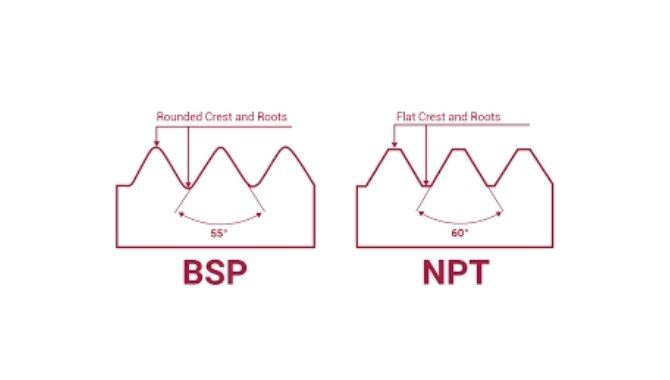
Material
Needle valve bodies are made in a variety of materials, however the primary consideration for the body of the needle valve is to make it durable enough to resist corrosion and also to allow the needle valve to operate in very low temperatures.
316 Edelstahl: it is the general-purpose valve. Good corrosion-resistance, good temperature-range and generally adequate for all industrial applications.
304 stainless steel: it has slightly lower cost than 316. A little less resistant to corrosion. For clean water, air or mild chemicals, it is a good, lower-cost alternative to 316.
Brass: it is for water, air, and low pressure only. Lower cost. Good for plumbing. Not for corrosive media or high temperatures.
Special alloys (Monel, Hastelloy, Inconel, Alloy 20, Duplex): They are for corrosive media, high temperatures, seawater, or sour gas. Expensive. Only needed if 316 stainless steel is not enough.

Packing material
Packing encircles the stem. It is used to seal around the handle of the needle valve to prevent leakage.
PTFE: Standard. Temperature range -54°C up to 200°C. Low friction, smooth operation. Suitable for most applications.
Graphite: Optional. Good from -50°C up to 570°C. Suitable for use with high temperature steam, hot oil or thermal fluid.
If the process temperature is 200°C, PTFE would be the normal choice for this application as it is better than Graphite at lower temperatures. However, if the process temperature were to rise above 200°C then Graphite would be more suitable for this application.

Vent port or not
Standard needle valves are used to isolate an instrument, but when completely shut off, pressure on the instrument side of the needle valve is trapped. This can create problems when the instrument is removed from the needle valve as pressure is released with force through the opened up hole left by the removed instrument. Severe injury can result.
A needle valve with a vent port can be opened up when closing the main valve of the needle valve. The small opening of the vent port then can release the pressurized fluid. The gauge then reads “0” and it is safe to remove your instrument without any spray of fluid.
Vent ports are recommended for applications where needle valves are used in front of pressure gauges or other pressure transmitting instruments (e.g. for monitoring pressure).
Where to Go from Here
- Need to understand the basics first? Read What Is a Needle Valve and How It Works
- Want to see where needle valves are used and get answers to common questions? Read Anwendungen und häufig gestellte Fragen zu Nadelventilen


