


Instrument valves are also known as precision valves. They are used to isolate and/or control small flows of fluid and gas within a process. If you work with pressure gauges, process analyzers, process samplers or with process transmitters then you may have already encountered an instrument valve. The purpose of this article is to explain the three most common types of instrument valve (Needle, Ball and Manifold) and also to provide some guidance on when to use them.
1. What Is an Instrument Valve?
An instrument valve is a term used for a specific type of valve which is used in an instrumentation system. The function of an instrument valve can be to isolate, control or vent a pressure gauge, a transmitter, an analyzer etc..
Industrial valves are designed for use on relatively large bore pipes to control large amounts of fluid. Instrument valves on the other hand are designed for small tubing connections (1/4” to 1”) and are used to control the amount of process media delivered to an instrument, or to isolate connections to an instrument.
Common applications include:
- Isolating pressure gauges for replacement or calibration
- Block-and-bleed service for transmitters
- Sampling systems
- Vent and drain ports
- Analyzer connections
2. صمام الإبرة
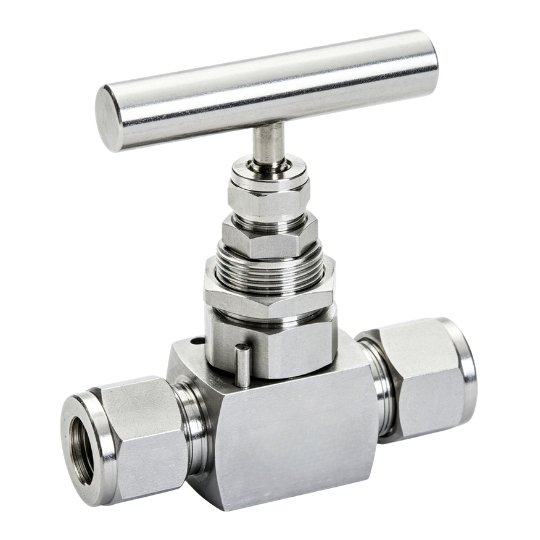
The needle valve is the most typical type of an instrument valve. The function of a needle valve is to control the flow of a fluid.
The slender tapered plunger (needle) gradually opens the precise seat to control flow.
By virtue of its long, finely threaded stem and tapered tip (a needle), the opening of the seat is gradually increased or decreased as the handle is turned. The amount of flow increased or decreased by each turn of the handle is very small.
Needle valve key features:
- Excellent flow control precision
- Leak-tight shut-off
- Globe-style flow path
- Available with non-rotating stem tip (extends valve life)
Packing options:
PTFE for standard service up to 232°C
Graphite for high temperature steam up to 538°C
Good for: Chemical injection, Hydraulic systems, Instrumentation panels, Gas sampling.
Limitations: Lower flow capacity than ball valves. Takes many turns to fully open or close – not for quick shut-off.
3. Ball Valve (صمام الكرة للأجهزة)
Ball valves used in instrumentation are used to isolate a process loop and are not used for flow control.
The Ball Valve (Instrumentation Ball Valve) is a type of valve used for on-off isolation and is not recommended to be used for flow control. This type of valve uses a hollow, rotating ball which is typically turned a quarter of a complete turn (open) to allow for free flow through the valve.
Ball valve key features:
- Quick shut-off – quarter-turn operation
- Visual indication – handle position shows open/closed
- High flow capacity (straight-through path)
- Easy to lock out and tag for safety
- Available in fire-safe designs
Good for: Instrument isolation, transmitter isolation, double block and bleed service, sampling systems, etc.
Limitations: Ball valves are not for use as flow controls or as pressure-reducing valves as they can be damaged by the valve seat.

4. صمام مشعب
There are manifolded valves which have several individual valves as part of a single block. These types of valves are often found mounted to the pressure transmitter as well as the differential pressure transmitters.
The manifold is composed of several valves connected in a block. Typical configurations for these are 2, 3 or 5 valves.
Manifold valve key features:
- Fewer leak points than separate valves and fittings
- Compact footprint on instrument panels
- Available with bellows seal or stem packing
- Various end connections: tube, NPT, socket weld
Good for: Used with DP transmitters to allow safe isolation, zeroing and venting/bleeding of instruments safely.
Types of manifolds:
- 2-Valve Manifold: A block valve and a bleed valve are combined in one manifold. This manifold is mainly used for gauge type pressure instruments.
- 3-Valve Manifold: A 3-Valve Manifold configuration is set up with 2 block valves for the high and low sides of the process and 1 equalizing valve for the process. Before closing the block valves, open the equalizer. This balances pressure on both sides of the transmitter. Without this step, closing the block valves could trap high pressure on one side and damage the sensor.
- 5-Valve Manifold: 2 block valves, 1 equalizer valve and 2 bleed valves. The 5-Valve Manifold is identical to the 3-Valve Manifold except for the additional calibration ports. These ports allow for venting of both sides of the transmitter and for connection of the various pieces of calibration equipment through these ports.
Limitations:
- Manifold valves are more complex to repair than individual valves: if one valve fails, the entire manifold may need replacement
- Manifold valves have higher upfront cost than buying separate valves
- Manifold valves are limited to transmitter mounting: not for general piping use
- Manifold valves have standard configurations only: custom layouts are expensive

5. Needle vs Ball vs Manifold – Which One Do You Need?
| نوع الصمام | الوظيفة الأساسية | عملية | الأفضل لـ |
| Needle | Precise flow control | منعطفات متعددة | Chemical injection, gas sampling, hydraulic control |
| Ball | On-off isolation | Quarter-turn | Instrument isolation, quick shut-off |
| Manifold | Isolation + vent + equalize | منعطفات متعددة | Pressure transmitters, differential pressure transmitters |
Quick selection guide:
Needle valve: Higher upfront cost than a ball valve, but lasts longer. Takes many turns to open or close, not for frequent cycling.
Ball valve: Lowest cost of the three. Handle position shows open or closed at a glance, reducing operator error.
Manifold valve: Highest upfront cost, but saves on installation labor. One block replaces multiple valves and fittings, saving panel space. Downside: if one valve fails, you may need to replace the entire block.
6. Other Instrument Valve Types (Brief Overview)
Needle, ball and manifold type valves are by far the most common of the so-called instrument type valves. A wide variety of additional types are also available for specific applications, however.
Gauge Valves & Gauge Cocks: They are supplied with various connections (i.e. 1/4” BSP etc) and are simple shut off valves fitted directly between the process line and the pressure gauge. The Gauge Valve allows safe removal of an instrument from service, even when the process media is at high pressure. Gauge Cocks are often supplied as part of a Gauge Protection Package and also allow for the safe servicing of the pressure gauge itself.
Check Valves: These are uni-directional valves which allow flow in one direction only. They are used to prevent back flow of a process fluid, which can cause a dangerous pressure surge or allow contamination of the system.
Bleed & Vent Valves: This type of valve releases air or another medium from the lines or from the interior of a number of different types of instrument while servicing or checking for accuracy of that instrument. The bleed valve relieves pressure from a variety of different types of instrument.
التعليمات
Q1: Can I use a needle valve for on-off service?
Yes, a needle valve can shut off flow completely. But it is not designed for frequent on-off cycling. The seat will wear out faster if you open and close it several times a day. For frequent cycling, use a ball valve.
Q2: Can I use a ball valve to throttle flow?
Not recommended. Ball valves are designed for on-off service. Using a ball valve to throttle flow can damage the seat over time. For flow control, use a needle valve.
Q3: What is the difference between a 3-valve and a 5-valve manifold?
A 3-valve manifold has two block valves and one equalizer. A 5-valve manifold adds two bleed valves – one for each side. The extra bleed valves allow you to vent each side separately and connect calibration equipment.
Q4: What happens if I close the block valves before opening the equalizer on a 3-valve manifold?
Trapped pressure on one side of the transmitter can damage the sensor. Always open the equalizer first, then close the block valves. This balances pressure on both sides before isolation.
Need Help Selecting the Right Instrument Valve?
Our instrument valves (Needle valves, Ball valves and manifold valves) are supplied in stainless steel or other special alloys. We have a variety of end connections for instrument valves including NPT, BSP or metric threaded ports. Sizes range from 1/8” to 1” and full traceability is provided for all components. A Material Test Certificate (MTC) is supplied for every batch of instrument valves.
اتصل بنا to discuss your specific application requirements including pressure, temperature, fluid and function, and we shall be happy to supply the correct instrument valve for your requirements.


