


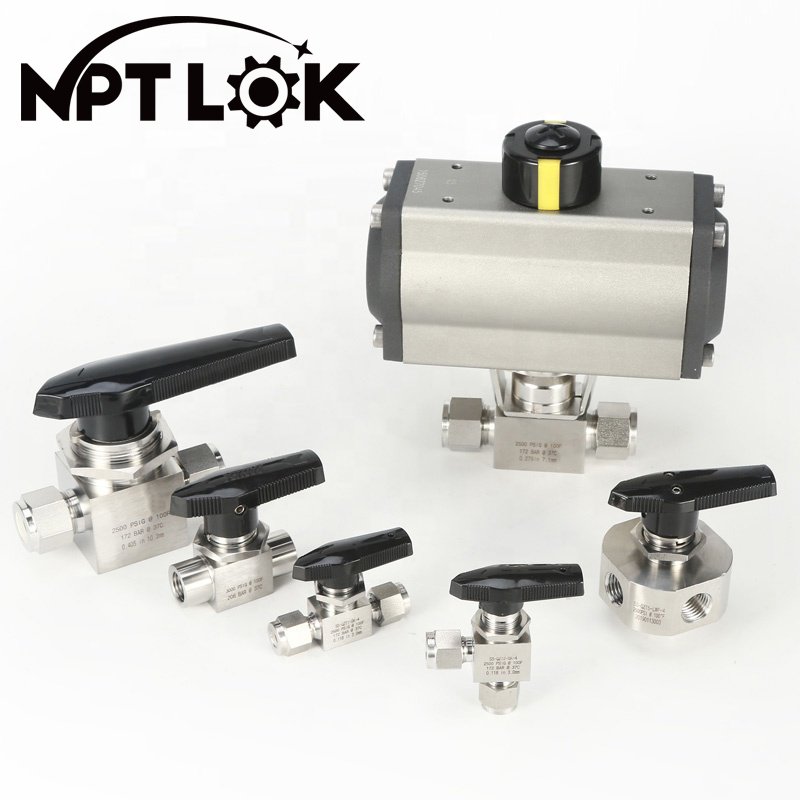
Instrument-grade ball valves, also called Instrumentation ball valves, are fundamentally different from standard pipeline ball valves in high-pressure sealing and fugitive emission control. While standard valves handle large-diameter bulk flow, instrument valves are built for small-bore systems (1/4“ to 1”) where zero leakage, low torque, and compact size matter. This article covers how instrumentation ball valves work, what makes the floating-ball seal so reliable, and what to check when performance falls short.
The Working Principle of an Instrument Ball Valve
The Quarter-Turn (90°) Operation Mechanism
A quarter-turn is all it takes. Handle parallel to the pipe means open. Perpendicular means closed. The ball rotates 90°, aligning or blocking the bore in an instant.
This simple motion delivers full open-to-close response in under one second — fast enough for emergency shutdowns, yet simple enough for daily isolation tasks
The Floating Ball Self-Energizing Seal Principle
Instrument ball valves typically adopt a Floating Ball design. Unlike trunnion-mounted valves where the ball is fixed by upper and lower support bearings, a floating ball is connected only via the stem.
When upstream pressure builds, it pushes the ball downstream against the seat. The higher the pressure, the tighter the seal. Engineers call this a “pressure-assisted” seal: the system pressure itself does the work.
This mechanism works across the full pressure range. At low pressure, the seal is tight. At high pressure, it’s even tighter. That’s why floating ball valves deliver bubble-tight shut-off even in high-pressure gas service—the force trying to push through the valve is exactly what seals it closed.

Floating vs. Trunnion-Mounted
Floating Ball
Ball connected only via stem; relies on media pressure to push against seat for sealing. Suitable for small-bore (1/4″~1″) instrument valves—simple structure, low cost, low operating torque.
Trunnion-mounted
Ball supported by upper/lower trunnion bearings that absorb pipeline thrust, reducing operating torque. Suitable for large-bore (2″+) or ultra-high-pressure pipeline valves—complex structure but high load capacity.
In short, floating ball valves are preferred in instrumentation; trunnion-mounted valves are more suitable for large pipelines, subsea, and similar severe conditions.
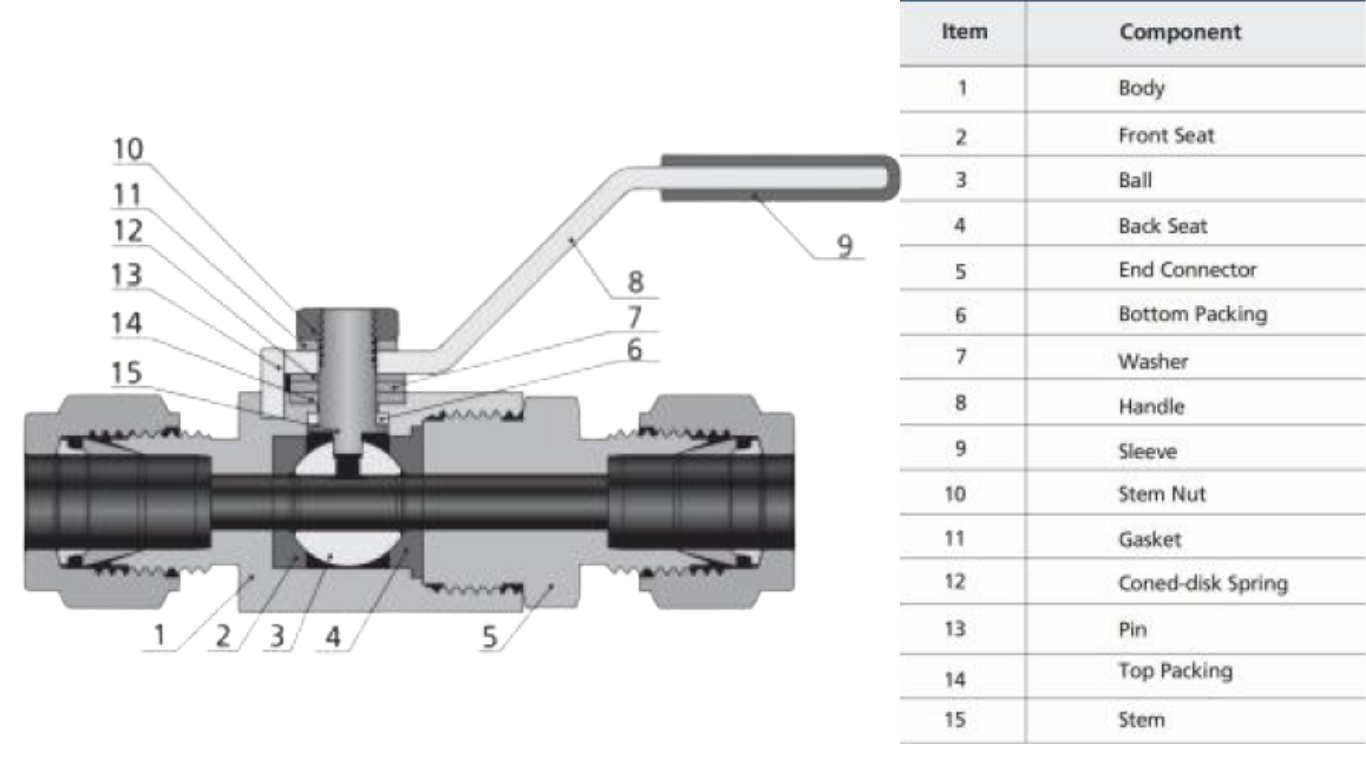
Key Components of Instrumentation Ball Valves and Their Functions
جسم
Pressure-containing shell, instrument-grade typically uses 316 SS(ASTM A182) or corrosion-resistant alloys.
Selection Guide:
| مادة | الأفضل لـ | Key Consideration |
| 316 SS | General instrument applications | Standard choice; good corrosion resistance |
| 316L SS | Welded constructions / chloride environments | Lower carbon content reduces sensitization |
| 304 SS | Mild, non-corrosive media | Lower cost but less corrosion resistance |
| Hastelloy / Monel | Severe corrosive / seawater / high-temperature acidic media | Premium alloy for extreme conditions |
| Duplex SS | High-pressure / chloride / sour gas (NACE) | Higher strength than 316; excellent pitting resistance |
For hydrogen service, 316 or 316L austenitic stainless steel is recommended. Use 316 or Duplex under seawater or high-chloride environments,
Ball
Floating core component with precision-drilled bore; surface requires mirror polishing to reduce friction.
Selection Guide:
Surface finish is critical. Mirror-polished ball surfaces reduce friction against seats, extending seat life and lowering operating torque.
Under frequent open/close, consider hardened 316 or satellite-coated balls to resist wear.
For corrosive or abrasive media, the ball material should match or exceed the body material’s corrosion resistance.
Seats
Typically PTFE (≤200°C) or PEEK (≤250°C+), providing resilient sealing and wear resistance.
Selection Guide:
| Criterion | PTFE | PEEK |
| Continuous Temperature Limit | ≤ 200°C (392°F) | ≤ 260°C (500°F) |
| Peak Temperature | ~260°C (500°F) | Up to 315°C (600°F) |
| Chemical Compatibility | Excellent (virtually universal) | Good (less universal than PTFE) |
| Mechanical Strength | Lower — prone to creep / cold flow | High — excellent dimensional stability |
| Wear / Abrasion Resistance | Moderate | Superior |
| يكلف | Lower | Higher |
| Best Application | General instrument service, ≤200°C, non-abrasive media | High-temperature (>200°C), high-pressure, abrasive media, or frequent cycling |
PTFE is the go-to choice for most applications, it handles temperatures up to 200°C, costs less, and resists just about any chemical you throw at it. Good value, solid performance.
Temperature climbs above 200°C? PTFE starts to soften and lose strength. That’s when you step up to PEEK. It takes more heat (up to 260°C continuous), and if your media carries abrasive particles, PEEK’s wear resistance is a clear upgrade.
On the other end of the thermometer, cryogenic service below -50°C, PCTFE is worth a look. It stays tough where PTFE turns brittle.
One more thing about PTFE: it creeps. Under sustained high pressure, it slowly deforms, cold flows over time. That can compromise sealing integrity in long-term high-pressure service. PEEK doesn’t have that problem. If your application runs 24/7 at high pressure, factor that into your decision.
Stem
The stem is the link between the handle and the ball. Turn the handle, the stem turns with it, and that rotational motion passes down to the ball. Simple enough—but in instrument valves, the stem has to do more than just transmit torque.
The critical feature here is blow-out-proof design, means the stem is mechanically locked in place. Even if the packing fails—even if there’s nothing left to hold it from the outside—internal pressure cannot shoot the stem out like a bullet. This is a safety-critical feature in high-pressure gas service.
Selection Guide:
For high-cycle applications, choose stems with hardened surfaces to reduce wear at the packing contact area; For corrosive service, the stem material should match the body material to avoid galvanic corrosion.
Packing
Packing seals the stem to prevent media from leaking to atmosphere. Standard options are PTFE or graphite.
PTFE packing cold-flows over time, requiring periodic re-torquing.
For ultra-low emission applications—EPA Method 21 compliance, for instance—choose live-loaded packing. Spring washers maintain constant compression automatically, eliminating manual re-torquing.
| مادة | نطاق درجة الحرارة | الأفضل لـ |
| PTFE Packing | -65°F to 450°F (-54°C to 232°C) | General instrument service, low torque |
| تعبئة الجرافيت | Up to 650°F (343°C) + | High-temperature applications |
| Fluorocarbon FKM / Buna-N | -40°F to 250°F (-40°C to 121°C) | O-ring seals in moderate service |
Instrument Ball Valve vs. Standard Ball Valve
| الأبعاد | صمام كروي للأجهزة | Standard Industrial Ball Valve |
| Design | Floating ball, precision-machined, micron-level tolerances | Floating or trunnion, standard industrial tolerances |
| تصنيف الضغط | عالي | Low to medium |
| Leakage Standard | Bubble-tight (< 0.1 SCCM nitrogen test) | Standard industrial leakage (some internal leakage allowed) |
| Port Configuration | 2-way, 3-way (L/T), 4/5/6/7-way multi-port | Mostly 2-way straight |
| Mounting | Panel mount, tube fittings, NPT threads | Flanged, butt-weld, socket-weld |
| Typical Application | Gauge isolation, transmitter venting, sampling, calibration | Pipeline bulk flow on/off |
How to Choose the Right Instrument Ball Valve?
Start with pressure and temperature. Match the valve to your system’s maximum working pressure—3,000, 6,000, or 10,000 PSI. Temperature then points you to the right seat: PTFE for up to 200°C, PEEK for higher heat, and PCTFE for cryogenic service below -50°C.
Next, consider the media. 316 stainless steel handles most instrument applications. For chlorides or seawater, upgrade to 316 with molybdenum. Severe corrosives call for Hastelloy or Monel. Hydrogen service? Stick with 316/316L. Sour gas? You’ll need duplex stainless or NACE-compliant materials.
Then decide on the flow path. Two-way for simple on/off, three-way L-port for diverting flow between two outlets, three-way T-port for mixing, and multi-port configurations for complex systems。
Connection type comes last. Tube fittings suit panel installations with frequent changes; NPT threads work for permanent pipe connections; flanged ends are for large-bore or high-pressure integration.
Still not sure? Here’s a shortcut.
HBB Series for general isolation up to 2,000 PSI, OIB Series for precision panel mounting up to 3,000 PSI, HPB Series for high-pressure/high-temperature up to 6,000 PSI, and TB/TBH Series for ultra-high-pressure or critical safety up to 10,000 PSI.
Typical Applications
Instrument ball valves are used across a range of applications where reliable shut-off and compact size are essential.
In gauge root valves, they isolate pressure gauges from process media, allowing online replacement without system shutdown. In DP transmitter manifolds (3-valve or 5-valve), they handle equalizing, venting, and calibration.
On hydraulic and pneumatic test benches, they are panel-mounted for quick on/off control of high-pressure gases and liquids. In chemical injection and sampling systems, bubble-tight sealing prevents hazardous media from escaping, protecting operator safety. And in gas distribution and control panels, they provide the reliable isolation that high-pressure gas service demands.
التعليمات
Q1. Can I use an instrument ball valve for throttling flow control?
No. Standard instrument ball valves are strictly on/off isolation valves. Throttling will erode the seats. If modulation is needed, choose a dedicated V-port ball valve.
Q2. How do I know if I need PTFE or PEEK seats?
If your media temperature is below 200°C, PTFE is standard. For high-temperature applications (above 200°C) or abrasive media, choose PEEK for better wear resistance.
Q3. What does “floating ball” mean in instrument valves?
It means the ball is not fixed by trunnions. Instead, it relies on upstream pressure to push the ball against the downstream seat, creating a tighter seal as pressure increases.
Q4. What is the difference between 2-way and 3-way instrument ball valves?
2-way is for simple straight on/off. 3-way L-port is for flow diverting (switching between two outlets). 3-way T-port is for mixing or full-bore multi-directional flow.
Q5. Do instrument ball valves require regular maintenance?
Yes. Regularly inspect the stem packing for external leakage and feel for abnormal increases in handle torque. For high-pressure gas applications, periodic leak testing is recommended.
اتصل بنا
NPTLOK has manufactured instrumentation ball valves for more than 20 years. Instrumentation ball valves are designed for sampling and conditioning systems, control systems, and medium-pressure applications.
يتكون صمام الكرة للأجهزة NPTLOK من مكون على شكل كرة، يحتوي على تغليف محكم لضمان التشغيل المحكم ضد التسرب ويوفر إغلاقًا إيجابيًا في تطبيقات الضغط الديناميكي.
صمامات الكرة للأجهزة مصنوعة عادةً من الفولاذ المقاوم للصدأ. تتحمل هذه الصمامات ضغطًا يصل إلى 3000 رطل/بوصة مربعة ودرجة حرارة تصل إلى 450 درجة فهرنهايت.
Download our كتالوج صمام الكرة or learn more معلومات عنا.
اختر صمامات الكرة الآلية وفقًا لمتطلباتك.


